

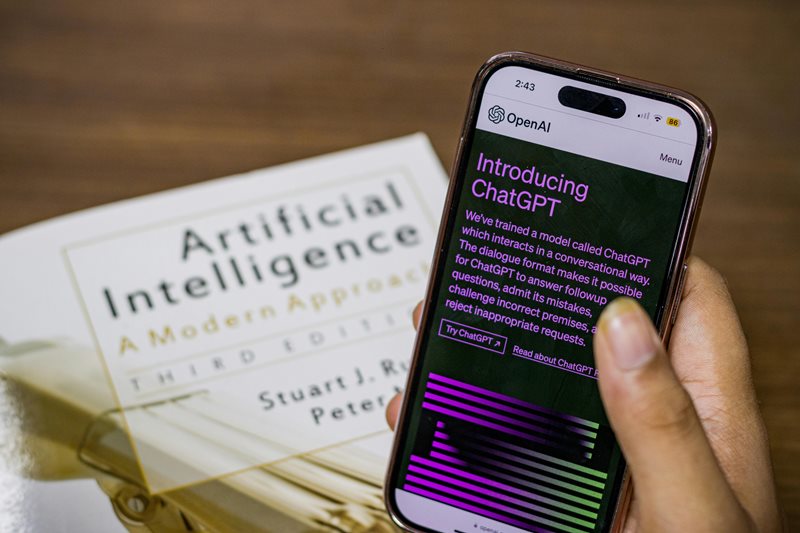
GEORGE NEWS - While the area of Generative Artificial Intelligence (GenAI) had been growing for some time, ChatGPT accelerated its adoption. Since then, schools and universities in South Africa, and further afield, have faced the question of how best to respond to GenAI’s use.
In 2025, the University of Cape Town (UCT), for example, announced that as part of its UCT AI in Education Framework, it would discontinue the use of Artificial Intelligence (AI) detection tools, such as Turnitin’s AI Score.
Shortly thereafter, IRIS, an AI-powered robot, was launched. IRIS can respond to voice prompts relating to school subjects from Grade R to tertiary level, in 11 of South Africa’s official languages (Phungula, 2025). In January 2026, meanwhile, Gauteng Premier Panyaza Lesufi called on the national government to equip learners and teachers with access to AI tools, while the North-West University (NWU) became the first South African university to adopt a formal AI policy spanning the domains of teaching, learning, research, assessment, and governance.
However, various individuals, including Dr Gillian Mooney, warn that AI could deepen inequality in Africa if it is rolled out without the necessary infrastructure, policies, and ethical safeguards, and without considering systemic barriers such as unreliable electricity, limited internet access, and outdated devices.
Prof Mishi, I, and countless other educators, know that the choices we make today will have far-reaching consequences, shaping what and how students learn, what they value, and how they see their place in the world. But in light of Dr Mooney’s warning, the question of how GenAI’s potential can be harnessed without compromising educational integrity or worsening inequality leaves many educators feeling overwhelmed because no clear answer seems to emerge. It is thus unsurprising that international research describes GenAI’s use in higher education as a “wicked problem”, an assessment that resonates with Paulo Freire’s argument that “all education is political”.
The complexity of navigating this wicked problem exposes the claim that GenAI is just the 21st-century’s calculator as an oversimplification. Think about it. Children are taught basic maths before they are allowed to use a calculator, ensuring they can understand the underlying processes and critically assess the calculator’s results. Furthermore, when calculators are allowed, responsible teachers encourage learners to use calculators whose functions and limitations they understand.
The same principle must apply to GenAI: before integrating it into our lecture halls, we must ensure both lecturers and students are equipped to engage with it critically and responsibly as findings from a recent Massachusetts Institute of Technology (MIT) study suggest that students who use GenAI after engaging in independent thinking often improve their performance. However, the same study cautions that failure to expose students to GenAI in a staged manner could result in a decline in students’ cognitive abilities.
 Image: Pexels
The “wickedness” deepens when balancing demands for the decolonisation of curricula with the knowledge that most GenAI models are overwhelmingly trained on texts and data from the Global North. If our students engage with these tools uncritically, they risk absorbing and perpetuating a single, dominant worldview, one that marginalises African scholarship and erodes the linguistic and cultural diversity that decolonisation calls for.
However, we would argue against a blanket ban on GenAI’s use as we feel that such a step is neither practical nor desirable, particularly as the workplace demands AI-literate graduates. Nor can we remain in a “Wild West” phase as unregulated or poorly integrated AI use threatens academic integrity and the quality of education. This is where frameworks like NWU’s AI policy offer a crucial starting point, and why voices like Dr Mooney’s resonate with us. And it was with the acknowledgement of the heavy burden lecturers face in operationalising policy, especially when confronted with wicked problems, that led Prof Mishi and me to develop the SCAFFOLD framework.
The framework is designed to thoughtfully integrate GenAI’s use into our lecture halls, starting with basic, guided applications and strong conceptual support in the first year and advancing toward more independent use at the postgraduate level, all while protecting academic integrity and widening access to meaningful learning.
SCAFFOLD is an acronym for Socratic questioning, Contextualisation, AI literacy, Formative feedback, Fairness and equity, Opportunities for graduate attributes, Lecturer’s enduring role, and Design for integrity. It provides a roadmap to move students beyond rote learning towards genuine understanding. While each component plays a vital role, we wish to emphasise that the core of the SCAFFOLD process is the lecturer’s role as a facilitator of deep learning and humaniser of education.
As it is through organising and guiding students’ interactions with GenAI, and embedding these interactions within a humanising pedagogy, that the lecturer creates a space for curiosity, agency, and ethical engagement. In this way, GenAI no longer serves as a black box, but an instrument of empowerment.
Furthermore, we argue that this critical lecturer-facilitated engagement with GenAI aligns with a philosophy of humanising pedagogy, as it places the student at the centre of learning and promotes education as a transformative, relational practice.
 Image: Pexels
To illustrate SCAFFOLD’s use in an undergraduate Economics class, we begin with a lecturer assigning a topic to their class and asking them to use an assigned GenAI tool to answer a series of questions. The chosen tool must be designed to act as a Socratic tutor, rather than an answer machine. The goal behind Socratic tutoring is to spark critical dialogue and to teach students the art of prompting while deepening their understanding of the assigned topic.
The next phase involves contextualisation. Here, we propose that the lecturer should ground abstract models, such as the Keynesian model, in local realities. For example, the lecturer might ask their students to trace the multiplier effects of a social grant on spaza shops in the Eastern Cape – a scenario unlikely to feature in a standard textbook from the Global North.
By contextualising the scenario and then asking students to evaluate the AI tool’s outputs, limitations, and biases, arguments that mainstream Economics education is narrow, uncritical, and detached from real-world problems are, to some extent, addressed. Simultaneously, various graduate attributes, including adaptive expertise and critical thinking, are developed.
The support phase tackles a very human problem: scale. In a class of 900 students, individualised feedback is often a fantasy. A well-designed GenAI tool can change that, offering immediate, tailored formative feedback. This is vital because research has established a clear link between the lack of detailed feedback and student failure.
We also argue that GenAI can become a powerful tool in supporting the first stage of decolonisation, which involves a process of “rediscovery and recovery”. You might be asking yourself how this could occur and how this contributes to fairness. Well, picture this: a student uses GenAI to explore the meaning of a concept like “crowding out” in isiXhosa, then explains its implications for their own community. This act affirms the student’s linguistic identity, centres lived reality, and disrupts the dominance of English in academic spaces.
Finally, SCAFFOLD ensures that we are building future-ready graduates without sacrificing academic integrity. Assessments have been redesigned using an AI assessment scale to ensure students can learn how to use AI ethically. In these cases, students are asked to submit their final assignment alongside a reflection on how they used AI, what prompts they used, and how they critically refined the output. This has moved us from policing a tool to cultivating responsible, problem-solving partners.
We began by framing GenAI as a “wicked problem” that challenges a university’s commitment to excellence, social justice and equality. However, while acknowledging that excellence in the face of GenAI tools can no longer be measured by the recall of information alone, we argue that when students are taught to engage with GenAI critically and responsibly, academic standards are not lowered; rather, they are raised to meet the demands of a new world.
Furthermore, if South African universities choose to shape GenAI use with care, purpose and humanity, we can transform a potential threat into a catalyst for transformation. Ultimately, this is how we can also ensure that AI supports Nelson Mandela University’s motto to “change the world”.
Sharon Tessendorf is a lecturer in Economics in the Department of Economics at Nelson Mandela University. This piece reflects her critical reflections, with inputs from Professor Syden Mishi, Professor of Behavioural Economics and Acting Deputy Dean in the Faculty of Business and Economic Sciences at Nelson Mandela University. The views expressed are those of the authors and not necessarily reflective of the university’s stance.
‘We bring you the latest Garden Route, Hessequa, Karoo news’