

GEORGE NEWS - Last week’s launch of the Waste Wise Business Pledge by George Municipality, in collaboration with Henque Waste and Garden Route District Municipality, highlighted the importance of businesses taking greater responsibility for waste management.
But what happens after recyclable materials leave your recycling bag, and why does it matter whether that mayonnaise jar was rinsed before being thrown away?
According to Henque Waste’s CEO, Douw Bezuidenhout, recycling is about far more than reducing the amount of waste sent to landfill. It is about protecting the Garden Route’s natural beauty, creating employment, conserving resources and changing the way communities think about waste.
“The recycling journey does not begin at the sorting facility,” he said. “It begins with the person standing in front of the bin.”
George Herald recently visited Henque Waste’s recycling facility to learn more about what happens behind the scenes and why every household can make a meaningful contribution.
A passion rooted in family
Bezuidenhout’s passion for preserving the environment began with his parents, Charlotta and Stephan, who established their first recycling business in Riversdale 20 years ago.
In those early years, it took three months to fill a single truck with recyclable material. Today, Henque Waste dispatches between three and five truckloads every week. The business later expanded to George, where the family established a recycling plant in 2010. Since then, the operation has experienced remarkable growth.
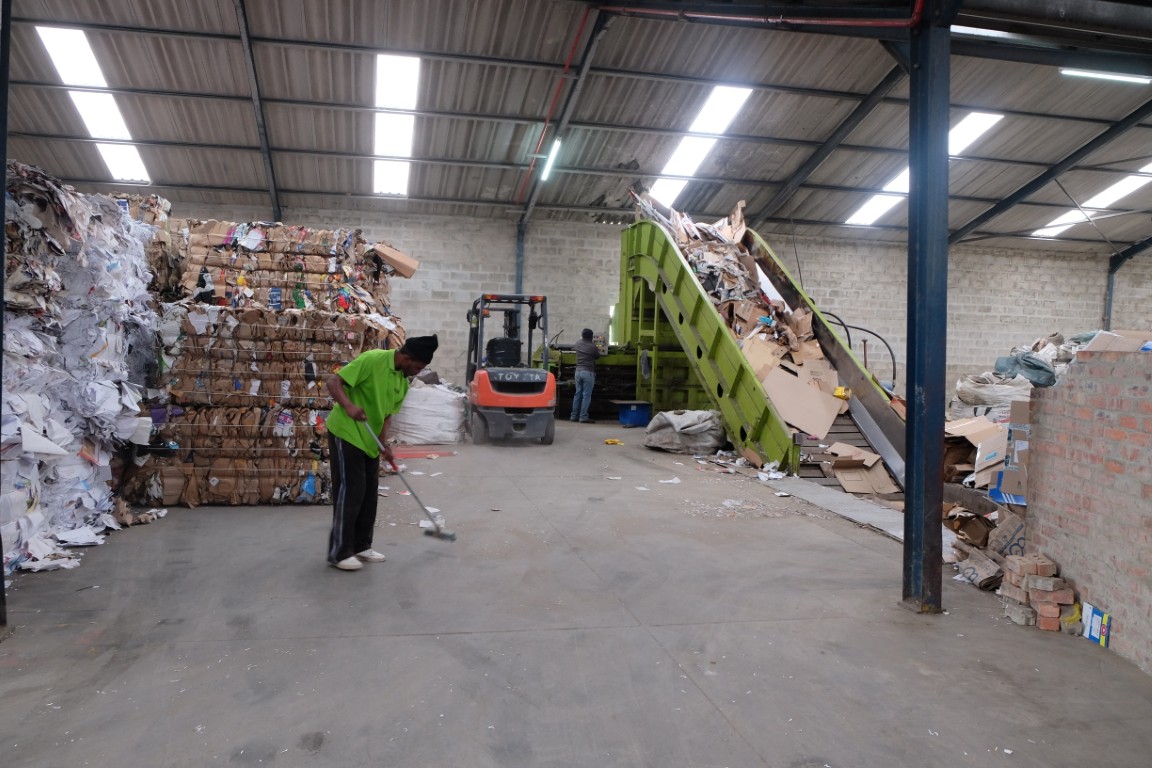 A Henque Waste employee sweeps the recycling facility floor in front of bales of compacted recyclable materials, while a conveyor belt transports cardboard boxes for sorting and processing. Photo: Marguerite van Ginkel
Henque Waste has also developed a strong and continued working relationship with George Municipality through the city’s blue bag recycling initiative and other environmental education programmes.
Bezuidenhout believes this collaboration demonstrates what can be achieved when local government, service providers, businesses and communities work together towards a shared environmental goal.
Although Bezuidenhout originally intended to study medicine, his desire to help people never changed. Instead, he found a different way of making a difference. His business today is built on three pillars: environmental sustainability, job creation and youth development.
More than protecting the environment
While recycling is often viewed primarily as an environmental initiative, Bezuidenhout believes its economic value is frequently overlooked.
Henque Waste employs 87 permanent staff members at its George operation. The company also works with independent waste pickers and members of its ‘bakkie brigade’, creating further income opportunities within the community. When these direct and indirect livelihoods are considered together, Henque’s recycling activities help support more than 200 households.
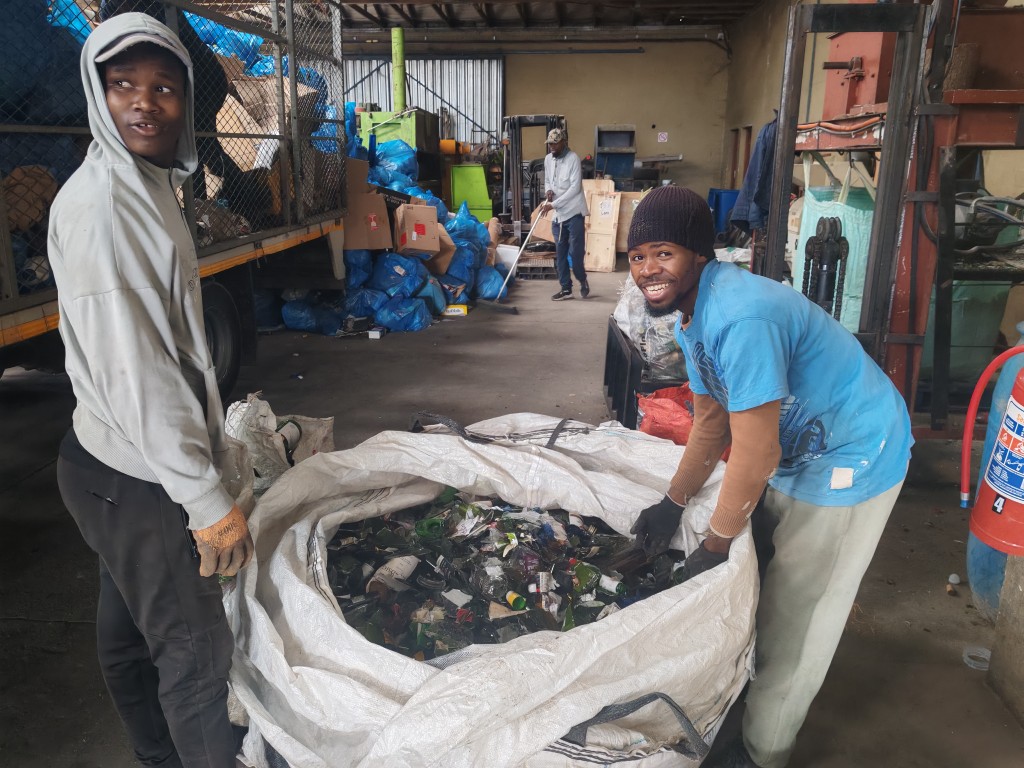 Liyabona King and Akhona Doti sort glass for recycling, while Milile Koti maintains the work area in the background at the Henque Waste recycling facility. Photo: Marguerite van Ginkel
Depending on the season, between 550 and 650 tonnes of recyclable material pass through the George facility every month. Despite these volumes, Bezuidenhout believes recycling remains one of South Africa’s most underutilised job-creation opportunities. “There is still a great deal of illegal dumping, contamination and a perception that waste is somebody else’s responsibility,” he said.
Instead, he believes every resident, business and organisation has a role to play in reducing the amount of waste sent to the landfill.
Recycling starts at home
One of the biggest challenges facing recycling facilities is contamination.
Bezuidenhout refers to one of the most common mistakes as ‘wish-cycling’ - placing items in recycling bags simply because people hope they can be recycled. Items such as nappies, sanitary products, animal waste, food waste, liquids and heavily contaminated packaging can spoil an entire bag of recyclable material, create health risks for workers and result in valuable recyclables being rejected.
His advice is straightforward: keep recyclable materials reasonably clean, dry and separate from general household waste. Plastic containers, tins, glass bottles, newspapers, office paper and cardboard can all be recycled.
Instead of using additional clean water to wash containers, households can rinse bottles, jars and tins in used dishwashing water before placing them in recycling bags. Even removing most of the food residue from a mayonnaise jar or tuna tin can make a significant difference.
Cardboard should be flattened and kept dry. When paper and cardboard become wet, soiled or mouldy, their fibre quality and recycling value deteriorate. The additional moisture also makes the material more difficult to store, handle and process.
 Esteline Swartz, Dameta Gevan and Will-Shunay Jordaan sort paper at the Henque Waste recycling facility. The specialised team ensures documents containing potentially confidential information are handled appropriately before recycling. Photo: Marguerite van Ginkel
Although polystyrene is technically recyclable, it is not currently processed in the Garden Route because transport costs are high and there is no viable local market for the material.
Getting started does not require an elaborate system. Bezuidenhout recommends separating waste into just two streams: one for general household refuse and another for clean, dry recyclable material.
Businesses can further improve their recycling performance by providing clearly marked bins, training staff and regularly reviewing what is being discarded.
Every item has a different journey
General household refuse and recyclable materials follow very different paths once they leave the kerbside.
General refuse is transported through the municipal waste management system for disposal at the landfill, where its remaining economic value is lost and it occupies increasingly limited landfill space.
Recyclable materials, however, are transported to sorting facilities, where they are separated into different material categories before being prepared for processing.
Plastics are sorted according to type and sent to specialist processors, where suitable materials may be washed, shredded and converted into raw material for products such as refuse bags, containers, piping, plastic furniture and other manufactured goods. Paper and cardboard are pulped to produce new packaging, paper products and moulded-fibre items such as egg cartons.
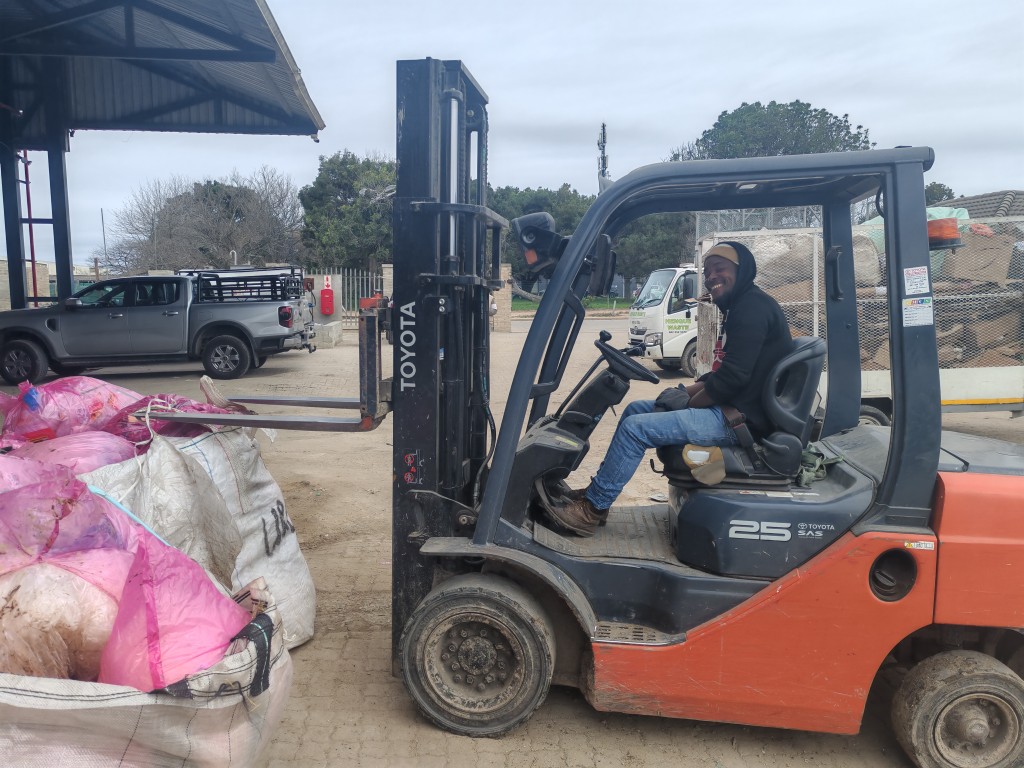 Forklift driver Ibrahim Mathiso moves large bags of recyclable material at the Henque Waste recycling facility in George. Photo: Marguerite van Ginkel
Glass is sorted according to colour, crushed and melted to manufacture new bottles and containers, while steel and aluminium cans are melted down and reused as raw material for new metal products.
By returning these materials to the manufacturing process, valuable resources remain in circulation instead of being lost to the landfill.
Investing in the next generation
Changing attitudes towards waste begins with education.
Three years ago, Henque Waste launched Project 10 000 to encourage schools to participate in recycling initiatives. A year later, Henque Waste joined forces with Monica Vaccaro of the Landmark Foundation and George Municipality to expand the programme.
Project 10 000 now includes 28 schools, with some participants broadening their environmental activities to include composting projects and vegetable gardens. Last year’s top-performing school was the George Voorbereidingskool.
Through the programme, learners are taught that recycling is not merely about collecting material. It is about responsibility, environmental awareness and recognising the value contained in what society often throws away.
A shared responsibility
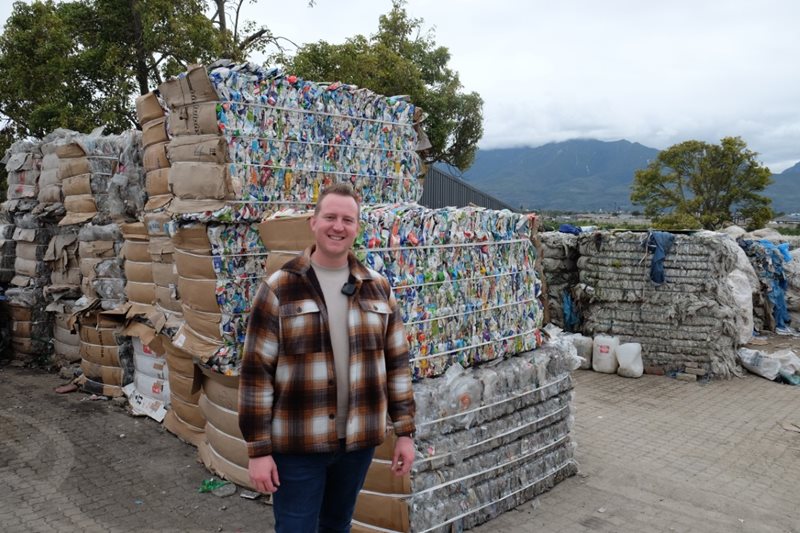
From the towering bales of recyclable material at the Henque Waste facility to the Outeniqua Mountains rising in the background, the connection between recycling and protecting the Garden Route is difficult to ignore.
Bezuidenhout hopes George can become one of South Africa’s leading examples of community-based recycling, where separating waste at the source becomes second nature in every household, school, business and public facility.
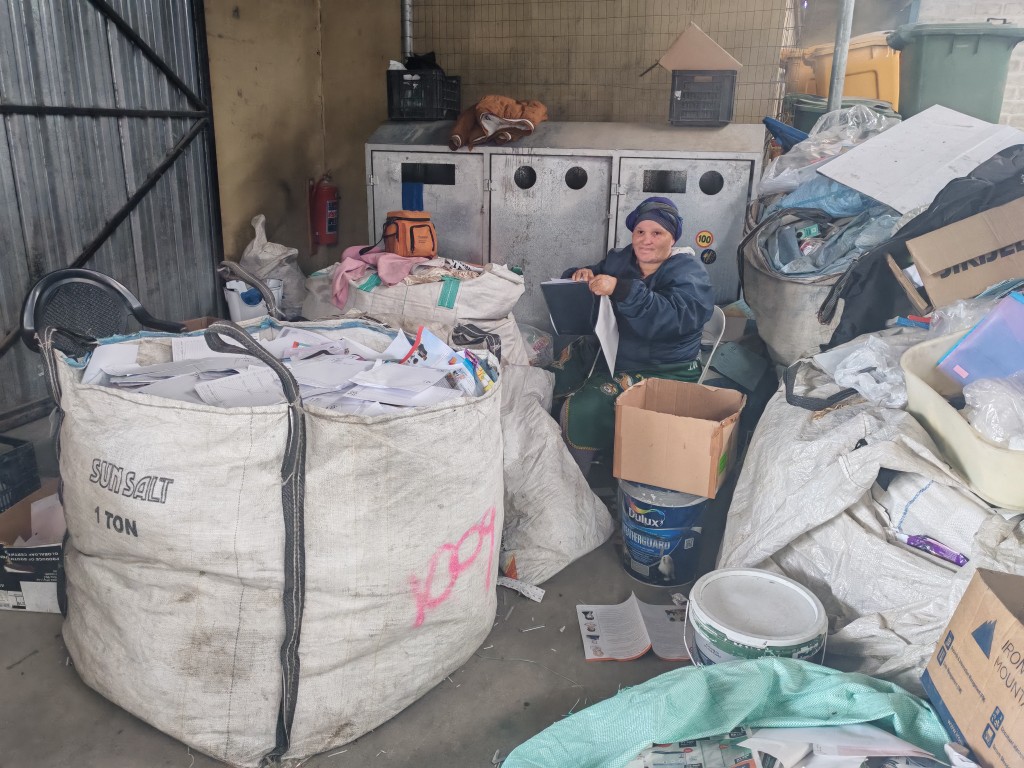 Juliana Mafu sorts paper for recycling, separating recyclable paper from hard covers and other materials that cannot be processed with it. Photo: Marguerite van Ginkel
Achieving that vision, he says, will require committed partnerships between government, waste service providers, businesses and residents.
The municipality provides environmental leadership and the public waste management framework. Service providers deliver the operational systems, while businesses and residents determine the quality of the recycling stream through the choices they make at the bin.
“We are honoured to live here,” Bezuidenhout said. “Let’s look after it.”
‘We bring you the latest Garden Route, Hessequa, Karoo news’