


GEORGE NEWS - Western Cape Mobility Minister Isaac Sileku encouraged the use of learner’s licence study guides while his department is trying to get to the bottom of the province’s 17% pass rate in the computerised learner’s licence test (CLLT).
Sileku was in George and Beaufort West last week for oversight visits to the local driving licence testing centres (DLTCs) to try and gather some insight into the low pass rate.
His visits follow a written parliamentary reply to questions of the FF Plus and the DA’s provincial spokesperson on mobility, Prof Nomafrench Mbombo, which revealed that the province had achieved an overall learner’s licence pass rate of 63% during the 2025/26 financial year, but the new CLLT recorded a pass rate of just 17%.
George Herald previously reported on local community frustration about the CLLT. Allegations were made of instances in which on average only one or two people out of a group of about 20 candidates would pass, despite them claiming thorough preparation.
Readers also complained about the long waiting times for rewriting dates, which adds months to the process of obtaining a learner’s licence.
Mbombo, who visited the George, Knysna and Bitou testing centres, said the parliamentary reply had revealed that 142 100 CLLTs were conducted in the Western Cape between 26 May 2025 and 9 July 2026. During that period, 61 136 first-time applicants and 32 061 repeat applicants wrote the test, while the overall provincial pass rate remained below 20%.
“These results warrant closer scrutiny to better understand the factors contributing to the low pass rate.”
Mbombo said during her oversight visits, one George resident said they had failed the test more than five times despite repeated preparation.
The officials at the Pacaltsdorp Testing Centre reported an improvement in the number of successful candidates, from one or two per group to five or six.
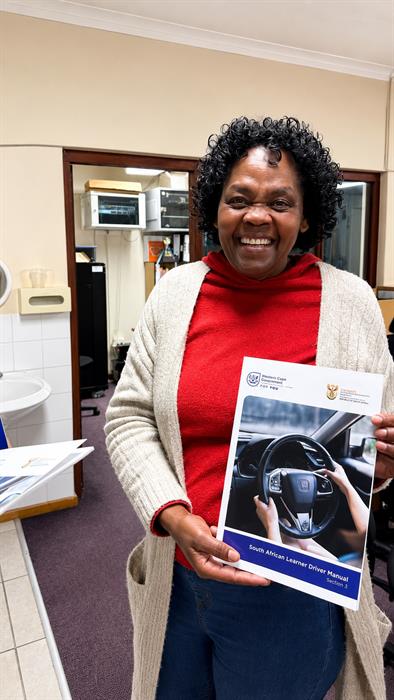 A senior library assistant at Thembalethu Library, Anet Kortman, with a study guide during Minister Isaac Sileku’s visit. Photo: Supplied
She said the applicants also complained that some questions appeared to have more than one reasonable answer, while the system recognised only one as correct. “These concerns warrant further investigation to ensure the CLLT fairly assesses applicants’ knowledge of the rules of the road, rather than their ability to interpret complex wording or ambiguous questions.”
Mbombo also said the parliamentary reply had indicated that the Road Traffic Management Corporation (RTMC) had not conducted an independent language proficiency assessment before the computerised system was introduced, and that the language editing and translations had been completed during the system’s initial development in about 2007. “It is important to determine whether the language, terminology and reading level remain appropriate and accessible for today’s applicants.”
Mbombo said she supports the CLLT system in principle, but it should be a credible system that strengthens road safety “by ensuring applicants genuinely understand the rules of the road rather than relying on memorised paper-based answers”.
Sileku also visited some public libraries where the study guides are available free of charge. He encouraged candidates to use these guides to give themselves the best chance of passing. The guides are also available at testing centres and online through the NaTIS platform.
‘We bring you the latest Garden Route, Hessequa, Karoo news’