

GARDEN ROUTE NEWS - With the devastating storms that recently battered the Garden Route still fresh in the minds of residents, the annual Garden Route Environmental Forum’s (Gref) Extreme Weather Reflection Summit could not have been more timely. Held at the Nelson Mandela University on Thursday 2 July, the summit brought together scientists, disaster management officials, academics and climate experts to reflect on the causes and impacts of the recent extreme weather events, discuss what lies ahead as the climate continues to change, and explore how communities can better prepare for an increasingly uncertain future.
“Brace for impact.”
That was the stark warning from Peter du Toit, founder of FutureClimate IQ, during the Gref Extreme Weather Reflection Summit.
Du Toit warned that the effects of global warming are accelerating, pointing to record-breaking ocean temperatures. He said global sea surface temperatures reached 20.88°C in June 2026, the highest ever recorded for this time of year. “What happens in the ocean does not stay in the ocean,” he said.
According to Du Toit, warmer oceans are disrupting weather systems, increasing atmospheric moisture and driving more frequent and severe extreme weather events. He warned that another El Niño has already developed, with possible impacts emerging as early as October 2026, potentially disrupting rainfall patterns.
 Anomalies and extremes in sea surface temperatures (ECMWF): This Copernicus/ECMWF map shows widespread ocean temperatures above the 1991-2020 average, with particularly exceptional warmth across much of the tropical Pacific, including the Niño 3.4 monitoring region. The pattern illustrates how elevated ocean heat is contributing to a warmer and more energetic climate system, with implications for weather extremes around the world.
Pre-emptive action
Closer to home, Du Toit said Nasa monitors rising sea levels in Knysna. Despite recent rainfall, he cautioned that water scarcity remains a serious concern as the El Niño intensifies and urged the George Municipality to maintain water restrictions, citing forecasts of below-normal rainfall in the coming months.
He also encouraged residents to familiarise themselves with the Garden Route District Climate Change Adaptation, Response and Implementation Plan, adopted in 2024, and to consider their own preparedness. “Have you assessed your risk? Do you have a resilience plan?” he asked.
 This multi-model forecast indicates an increased likelihood of below-normal rainfall across much of southern Africa, including large parts of South Africa, while wetter-than-normal conditions are favoured farther east and northeast. The outlook is probabilistic rather than a prediction of specific rainfall totals, but it signals an elevated risk of a drier late-spring and early-summer season in the region. Image: Columbia Climate School International Research Institute for Climate and Soc
Du Toit concluded that resilience planning is no longer optional. Governments, municipalities, businesses, families and individuals all need plans to prepare for increasingly frequent extreme weather events and the damage they are expected to bring.
Impact
Gerhard Otto, head of disaster management for the Garden Route District, said the severe storms that swept across the Garden Route caused widespread devastation, claiming four lives and leaving hundreds of people displaced.
 Damage to municipal infrastructure in Haarlem and Uniondale during the May and June 2026 floods. Photo: Garden Route District Municipality
The George municipal area, particularly the Langkloof, was among the hardest hit, with flooding damaging roads, trapping about 76 people and cutting off access to Haarlem, Uniondale and several farms. Across the district, strong winds uprooted trees, damaged homes and critical infrastructure, and caused widespread electricity and communication outages. More than 401 people were accommodated in community halls across the district, including more than 174 in Bitou. Bitou experienced severe flooding, voluntary evacuations and disruptions to water, electricity and telecommunications, while flooding also stranded 64 people at a resort near Oudtshoorn and caused extensive damage to Meiringspoort.
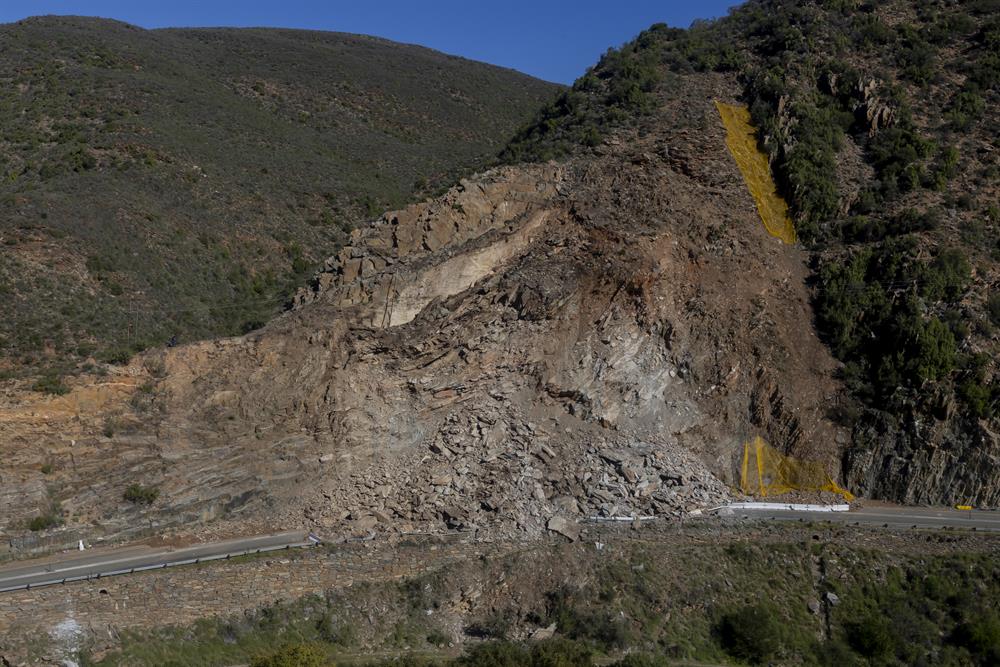 A major rock slide on the R328 between Oudtshoorn and the Cango Caves near De Kombuys forced authorities to close the route. The severe storm damage has repeatedly delayed stabilisation efforts. Photo: Garden Route District Municipality
Invasive species compound climate risks
Invasive species expert Dr Arne Witt warned that invasive alien species (IAS) are compounding the impacts of climate change and making extreme weather events more destructive.
Witt said climate change, habitat loss, pollution, overexploitation and invasive alien species are among the greatest threats to biodiversity. However, he stressed that IAS also affect agriculture, water resources and human and animal health, increase wildfire risk, accelerate soil erosion and worsen flood damage.
Citing recent research, Witt said the Western Cape has recorded the highest frequency of climate-induced extreme weather events in South Africa, with fires, floods and droughts becoming increasingly common. He pointed to international studies showing that invasive alien trees, particularly pines and eucalyptus, intensify wildfires, while alien vegetation along rivers contributes to flooding by blocking culverts and bridges and increasing erosion.
 Attendees and speaker participants: Dr Arne Witt, Selaelo Mapheto, NMU’s health, safety and environmental officer, Dr Ongama Mtimka and Brian Cochrane, chairperson of the Garden Route Dam Action Group (Gardag). Photo: Marguerite van Ginkel
Witt also raised concerns about the lack of resources for invasive species management, weak enforcement against non-compliance and poor co-ordination between government entities. He called for greater cooperation between authorities, landowners and communities, warning that tackling invasive alien species requires a co-ordinated, multi-sectoral approach rather than reactive responses after disasters.
For insurers, climate change is loss data, not a debate
Ebbe Rabie, CEO, Tiger Risk, Specialty Insurance Advisors, presented on what climate change and El Niño mean for insurance in our region. His message was simple: for insurers this is not a political debate. It is loss data.
The frequency and severity of weather losses have moved. Pricing models built on 30 years of history now under-predict what is actually happening. The past is no longer a reliable guide to the future. Globally, premiums for physical climate and natural catastrophe protection are expected to rise by roughly 50% by 2030, to between USD200 and 250 billion a year.
Why does that matter in George, Knysna and the wider Garden Route? Because in a region exposed to fire, flood and coastal erosion, an uninsured loss is not deferred. It is permanent. Recovery then depends on disaster grants and personal savings, and both are limited and slow.
 A wildfire in the first week of January 2026 affected more than 23km² in Mossel Bay, with several homes along the urban fringe/edge were destroyed. Photo: Chelsea Pieterse
Fires and floods are sudden, and we understand them. Sea-level rise and coastal erosion are slow, which makes them harder to insure and easier to ignore, right up until a property is literally undermined. Projections show measurable sea-level rise around Knysna by 2100. Combine storm surge with high tides on a rising baseline and you get repeated damage to the same coastal assets. Insurers will pay once, perhaps twice. Eventually they decline the risk.
The Garden Route National Park, our estuaries and the tourism infrastructure that supports thousands of jobs (camps, roads, bridges) sit directly in the firing line.
Rabie said that land-use planning and managed retreat are no longer just environmental questions. “They are risk-management tools. Where we allow building, and how we protect what already stands, will decide whether losses in this region stay insurable at all.”
‘We bring you the latest Garden Route, Hessequa, Karoo news’