

GEORGE NEWS - A mini indigenous forest in the Garden Route Botanical Garden (GRBG), envisioned to honour the 13-year-old Alexander Rhodes, who passed away on 20 May, is developing into something far bigger than his mother, Marelize, had imagined.
During his illness, Alexander had raised sponsorships to spoil his fellow child cancer patients with Christmas gifts, inspiring the creation of the non-profit organisation Alexander's Wish.
Following Alexander's brave battle with cancer, his family was overwhelmed with flowers and gifts. After the devastating storms that had stripped George of hundreds of trees just a week before his death, Marelize asked the well-wishers to donate trees instead of flowers. The trees will be planted in the GRBG to help restore the city's urban forest.
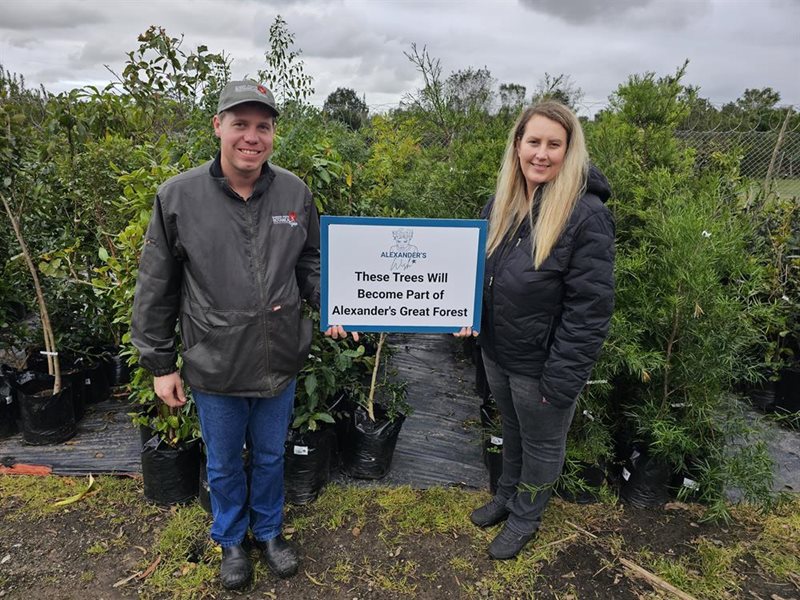
Her initial goal of 100 trees was quickly exceeded. The donations have already funded 330 indigenous trees, and a new target of 1 000 trees, or more, has been set. "The donated trees will become part of Alexander's Great Forest," said Marelize.
According to GRBG curator Christiaan Viljoen, the forest will feature indigenous species native to the Garden Route's Southern Afro-temperate Forest.
"These include the Cape blackwood (Maytenus peduncularis), the black and white ironwood (Olea capensis and Vepris lanceolata), the forest spoonwood (Cassine peragua ssp. peragua), the forest saffron (Elaeodendron croceum), the forest quar (Psydrax capensis), the black and white stinkwood (Ocotea bullata and Celtis africana), the assegai (Curtisia dentata), the hard pear (Olinia ventosa), the Outeniqua and real yellowwood (Afrocarpus falcatus and Podocarpus latifolius), the bladdernut (Diospyros whyteana), the white alder (Platylophus trifoliatus), the red alder (Cunonia capensis), the forest elder (Nuxia floribunda) and the Terblans beech (Faurea macnaughtonii), a rare species of significant conservation concern due to its fragmented populations."
Viljoen said the fast-growing nurse trees will also be planted to provide shelter while the slower-growing forest species become established.
Each donated tree will initially be geo-tagged and later fitted with a permanent metal tag bearing the donor's name and a QR code linking to a personal message from the donor.
"What started as a way to honour Alexander has become a project that belongs to the whole community. Every tree represents someone who chose life, hope and restoration," said Marelize.
Viljoen said the GRBG does not have enough space for such a large forest, but thanks to a happy confluence of circumstances, the project received an unexpected boost.
The George Municipality has been negotiating with the Department of Forestry, Fisheries and the Environment (DFFE) since 2025 to acquire about 27ha of state land adjacent to the GRBG for a proposed nature-based flood attenuation park.
According to the municipal director of Planning and Development, Mahlatse Phosa, the project aims to reduce flooding along the Camphersdrift River while creating a conservation area that could eventually be incorporated into the botanical garden. Forestry operations by Coldstream Timber Company, a service provider for DFFE on the affected land, have been placed on hold while negotiations continue, although the final approval will rest with the Council.
Marelize said the project is about much more than planting trees. "It is about hope, healing and creating a legacy that will continue to grow for generations."
The first planting events are expected to take place later this year, and community members, schools and volunteers are invited to participate as Alexander's Great Forest begins to take root alongside the GRBG.
To donate a tree costs R250. Contact Alexander's Wish NPC on 076 529 6753 if you wish to contribute.
‘We bring you the latest Garden Route, Hessequa, Karoo news’