


Sponsored Content
GARDEN ROUTE NEWS - Few would argue that the first five months of 2026 was a difficult time for investors worldwide. We experienced global and local events that had a compelling impact on market returns.
To name a few events we saw:
Globally:
- The war in Iran,
- energy crisis as oil prices increased,
- inflation shock, and
- a sharp decline in bond and equity markets.
In South Africa:
- A political crisis (the Phala Phala constitutional scandal), and
- mass outflows from our market.
Despite the rollercoaster of worldwide and local events experienced thus far in 2026, one should always have a long-term view when making decisions about your investment plan.
A financial adviser has the expertise to objectively manage your capital and savings throughout various worldwide and local events to help you achieve your investment goals.
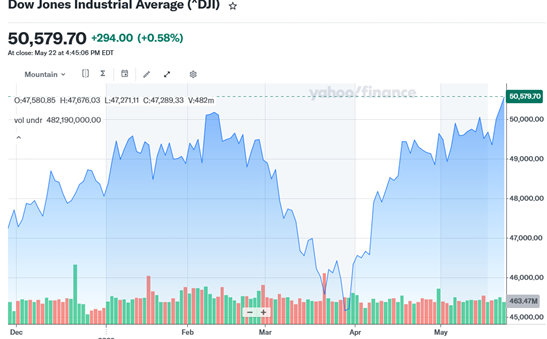
Markets go through cycles and recover. As reflected in the graph below, US Markets were down more than 10% from their high points earlier in the 2026 and as at the end of May, these markets fully recovered, reaching record-breaking numbers.
Investing capital to secure growth and diversification requires a dual strategy. Advisers generally allocate funds across various asset classes (stocks, bonds, real estate and cash instruments) and geographies to minimise risk, while including growth-oriented assets (like equities) to outpace inflation and compound long-term wealth.
1. The mechanics of growth investments
Growth investments focus on increasing the nominal value of capital over time, making it ideal for long-term goals. Further, they allow for:
- Equity exposure: Long-term data shows that growth assets such as equities are essential to outpace inflation. When growth is the primary objective, advisers generally invest 50% to 70% of a client’s portfolio in equities depending on the individual’s risk tolerance.
- Compounding: Leaving returns invested allows for growth on both your existing capital and the returns already generated.
2. Diversification strategies to protect capital
Diversification is a risk mitigation technique that ensures your portfolio is not overly reliant on a single asset or market.
- Asset class mix: A well-balanced portfolio mixes traditional assets like equities, bonds, property and cash.
- Sector spread: Sector diversification (e.g., not only technology or banking ) ensures that a downturn in one industry does not disproportionately sink your portfolio.
- Geographic/offshore exposure: Adding offshore exposure to developed markets like the US or Europe, hedges against local currency volatility and unlocks global opportunities.
Tools and resources
Diversifying doesn't necessarily translate into hand-picking dozens of individual stocks. One could gain exposure to multiple markets and companies by investing in unit trust funds.
Planning and investing through retirement phase
Capital preservation in retirement focuses on minimising major market drawdowns to avoid depleting your nest egg early. This is typically achieved by using a combination of strategies such as separating funds into cash, income and growth assets.
Sound strategy throughout retirement
Depending on your circumstances, an adviser will divide your retirement portfolio into distinct time horizons. This entails:
- Cash: Keeping three to four years' worth of living expenses in highly liquid, low-risk accounts like money market instruments to avoid selling assets during market downturns.
- Income: Allocating four to five years of expenses to fixed-income assets such as government or corporate bonds, offering stable yields without extreme volatility.
- Growth: Investing the remainder in equities and property stocks to outpace inflation and maintain long-term purchasing power.
Systematic withdrawal rates: Limit your initial withdrawals to a safe percentage of your portfolio - e.g., the standard 4% rule, adjusted for local inflation.
Diversification remains key
Most investment professionals agree that, although diversification does not provide a guarantee against losses, it is a critical component to reach long-term financial goals while minimising risk.
Having adequate exposure to both local and global markets and other asset classes such as bonds and cash, remains the key ingredient to help you achieve your investment goals.
Whether you are at the retirement savings stage, close to retirement or have already retired, as investment planning experts, PSG advisers are equipped to help you manage your investments in line with your unique needs to meet your financial goals.
PSG George

PSG Mossel Bay Diaz

‘We bring you the latest Garden Route, Hessequa, Karoo news’