

GEORGE NEWS - The farmers in Outeniqualand are facing increasing uncertainty and anxiety following the outbreak of foot-and-mouth disease (FMD) on the district’s doorstep.
The threat of the disease spreading is adding to the pressure from the ongoing drought they already have to contend with.
The Outeniqualand Farmers’ Association convened an emergency meeting on Monday evening, 9 February, after the Western Cape Department of Agriculture, Economic Development and Tourism announced a suspected case of FMD on a dairy farm near Hartenbos on Sunday. An area with a 10km radius around the farm was placed under quarantine.
George state veterinarian, Dr Leana Janse van Rensburg, on Wednesday 11 February issued a statement in which she “strongly” discouraged the continuance of livestock auctions in the George state veterinary area “ … as we currently have a confirmed Foot and Mouth Disease outbreak in the Mossel Bay area”.
“The outbreak in the area is still under investigation as to the extent of the affected properties and thus it would be irresponsible at this stage to continue with the gathering of animals from different sources, which may be in the incubation stage of infection, before the extent of the outbreak has been determined,” said Janse van Rensburg.
The district’s farmers had packed the John Steyn Hall at Sinksabrug for the meeting on Monday evening.
Just before it, George Herald received a WhatsApp message from the dairy farmer, George Kuyler of Skimmelkrans Farming, in which he expressed his fear: “I am shaking and scared, really scared. [FMD] will not only be a death sentence for our business. My animals, my people are becoming paranoid; they don’t want to go out. Don’t want to bring in the virus. SCARED.”
From the discussions during the meeting it emerged that the farmers are grappling with numerous uncertainties, including the authorities’ capacity to control the disease, the shortage of vaccines, the lack of control over stray livestock, and the absence of a nearby facility that offers double pasteurisation for milk. A suitable abattoir for the slaughter of infected carcasses is still being identified.
The attendees felt overall that the control over and policing of livestock transport are wholly inadequate, and Bossie Terblanche, the association’s chairperson, appealed to all farmers to be on the lookout for any suspicious vehicles transporting livestock. These must be reported immediately to the joint operations centre, which was established on Monday under the leadership of the state veterinarian, Dr Leana Janse van Rensburg.
Terblanche said there are seven access routes into Outeniqualand, and that the private sector would like to set up control points everywhere, but at a cost of about R1m per point per month, this is unaffordable.
Dr Muller Strydom, a private veterinarian of the George Animal Clinic, said five immediate control points have been set up on access routes around the 10km quarantine area. The points are manned by various role players such as the police, provincial traffic services and law enforcement officers.
The only permissible transport of livestock out of the area is to an abattoir. Control points are expected to be extended to the N2 at Bloukrans Bridge, the R62 (Langkloof Road), the N9 between Willowmore and Uniondale, and the N1 at Beaufort West.
Terblanche proposed that all auctions be put on hold. BKB has already cancelled its Outeniqua auction that would have taken place within the next week. “I think auctions will automatically be suspended as buyers are wary under these circumstances,” he said.
According to Dr Riaan Putter, a private veterinarian from George, the main cause of spread is the transport of animals. In 90% of cases in the Western Cape, the origin could be traced back to animals that had been transported.
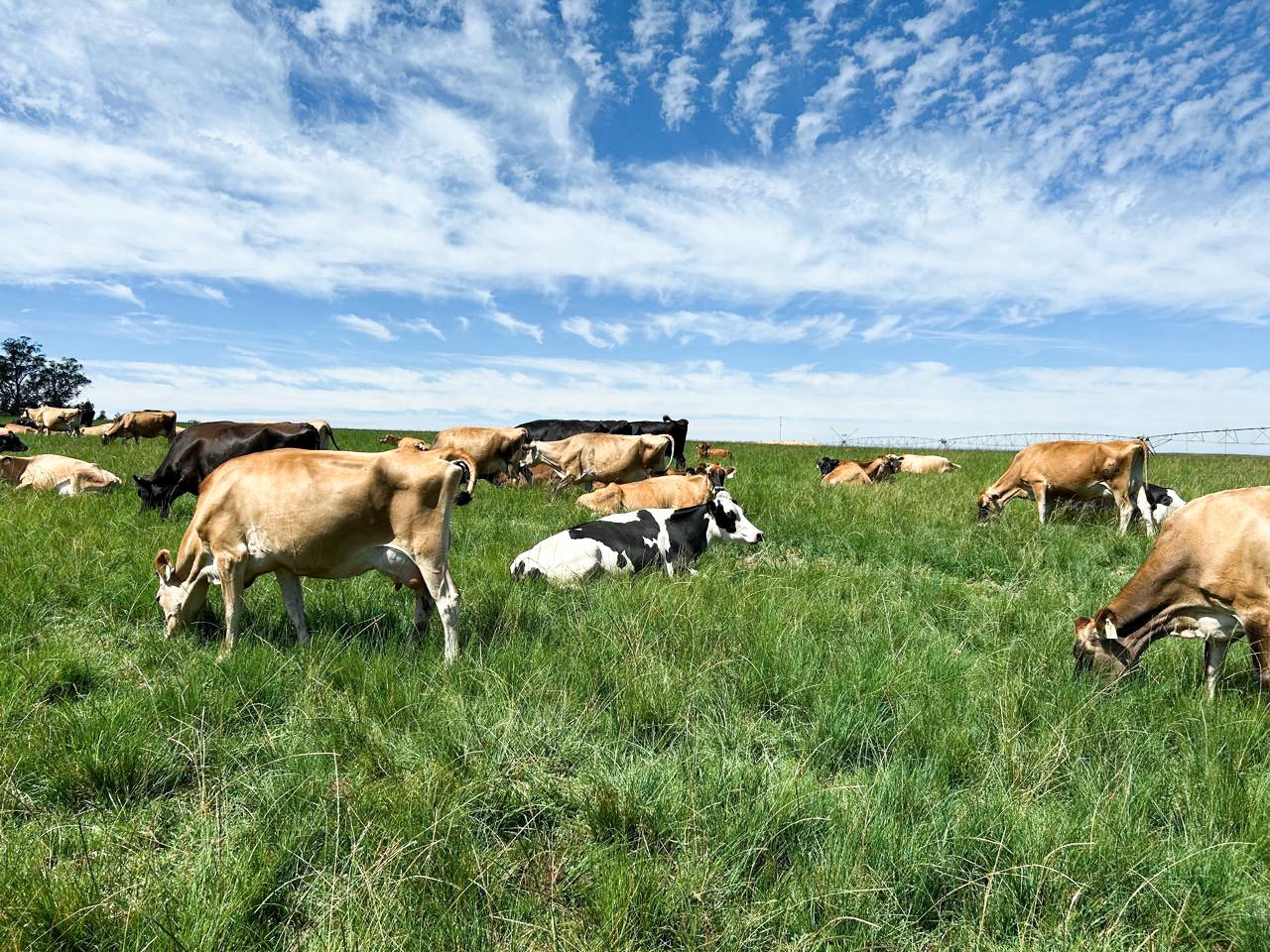 Cows of Skimmelkrans Farm near George.
Vaccines
Strydom voiced his concern that only 600 doses of vaccine were sent from Onderstepoort to the index farm, while 700 cattle on the farm itself still need to be vaccinated, and those on surrounding farms in the quarantine area.
“Where there is an outbreak like now, your best control is vaccination within the first 48 hours. It lowers the viral load in infected animals and curbs the spread. It also helps to reduce symptoms. This is a critical time.”
He said the Southern Cape’s veterinarians and farmers are unhappy that proactive measures had not been implemented sooner. They had handed a formal proposal to the animal health section of the provincial veterinary services in October for a strategy to strengthen biosecurity, surveillance and emergency preparedness. None of their proposals were implemented. “One of our suggestions was that enough vaccines be stored at Elsenburg for emergency situations. At the time, the supply of vaccines had not yet dried up, and if this had been done, we would not have been in the situation we are in now.”
Terblanche warned that farmers must implement proper biosecurity measures on their farms. He also advised dairy farmers to familiarise themselves with their milk buyers’ policies regarding milk from infected or vaccinated cows.
“At present, Parmalat in Gqeberha, Nestlé in Kareedouw and Woodlands in Humansdorp are the only factories equipped for double pasteurisation. Ask whether they will still purchase milk, and get your buyer’s answer in black and white.”
The Garden Route's Mayor Marais Kruger said in a statement earlier this week that the agricultural sector is critical, as it contributes about R14b to the Western Cape economy, and the containment and eradication of diseases must be managed in the best interest of jobs and the economy. It requires a collective effort.
‘We bring you the latest Garden Route, Hessequa, Karoo news’