


AGRICULTURAL NEWS - Ostriches have a long history in South Africa, dating back to their domestication in the late 1800s, primarily linked to the export of feathers, leather, and meat from commercial farms in the Western and Eastern Cape.
The industry is still export-oriented for leather and feathers, while meat increasingly targets both domestic and international niche markets. However, there is a growing story inland: emerging and small-scale farmers are finding real value in local markets where ostrich products are scarce.
I recently attended a small-scale ostrich producer training hosted by Bango Poultry in Gauteng and was impressed by what I experienced. About 25 emerging ostrich farmers compared notes, and the message was clear: if you focus on good care and local demand, an ostrich can pay its way many times over.
It looks like the local township and rural markets are determined to fly the ostrich commodities high, where almost nothing from an ostrich goes to waste. Feathers are used for traditional regalia and dusters, eggshells for crafts and medicinal properties, skin for small leather goods, bones for curios, and the meat is a rare and delicate treat for fewer households.
The South African Ostrich Value Chain Structure
The ostrich value chain features multiple products and stages: live breeding stock and chicks, feed and husbandry inputs, primary production, slaughtering and meat processing, leather processing and feather handling, and downstream marketing and export.
The vertical integration of processing facilities, stringent export standards, and concentrated buyer power create high entry barriers for small-scale producers who often lack aggregation mechanisms, market contracts, and the traceability systems required for export-grade products.
Furthermore, there is a fragmented producer organization, aggregation, and vulnerability to animal health shocks that disproportionately affect smaller operations when compared to commercial producers.
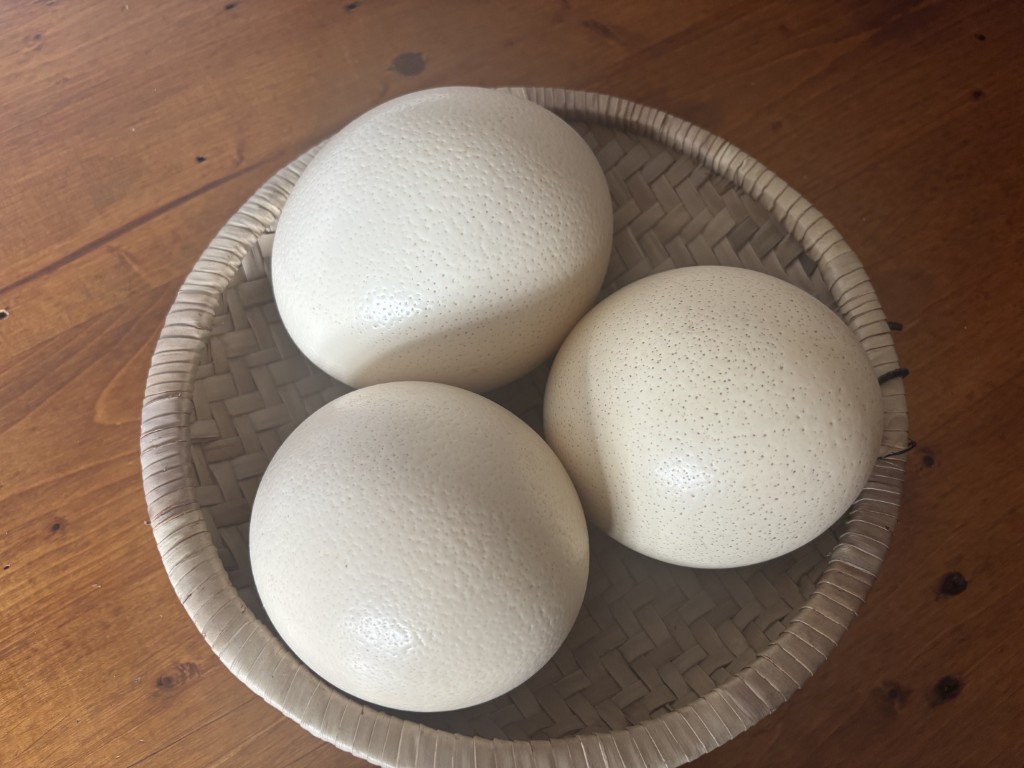 Ostrich eggs on an informal market.
Ostrich eggs have never featured as a viable commercial output for ostrich producers, except perhaps in the breeding market. However, emerging farmers and the local appetite for these rich and gigantic eggs are about to flip the script.
Ostrich eggs move quickly because they are valued in rituals and cleansing ceremonies in many local cultures. Because supermarkets seldom carry ostrich eggs, prices in informal markets are significantly higher and more inflated than in formal channels.
At the Bango Poultry Training session, I learned that ostrich eggs are selling at about R300–R600 each informally, versus around R60–R90 in formal outlets of the Southern Cape and the Karoo. Scarcity and proximity to the buyer create this premium.
For a small producer, that price gap can cover many of the additional costs associated with starting up a profitable ostrich enterprise outside the traditional ostrich regions.
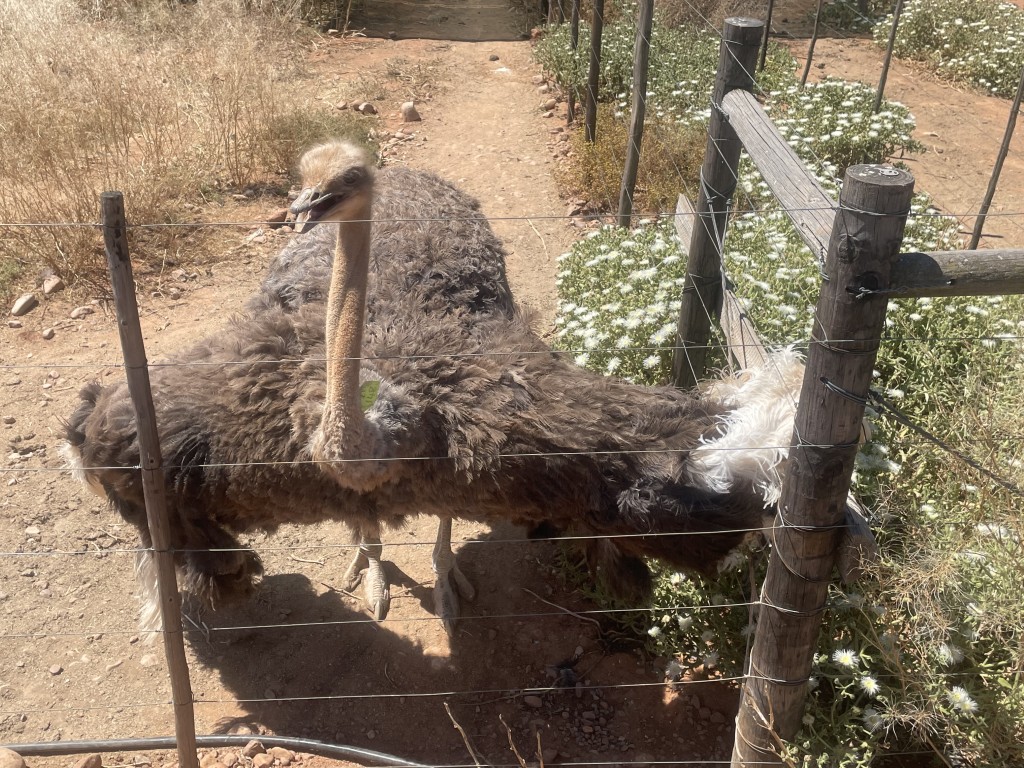
The export side of the ostrich industry is extremely efficient and specialized, with separate phases for breeding, rearing, and growing out, plus very strict production and processing standards. This system suits large commercial units and clustered supply chains, but it is hard for new smallholders to enter directly.
By contrast, the local inland market rewards reliability and quick delivery more than scale. A producer who can consistently supply clean eggs, reply to WhatsApp messages, and meet clients where they are will frequently win repeat business without a large marketing budget. Good husbandry is the foundation.
Ostriches are not just big, flightless chickens. Biosecurity is simple but vital: quarantine new birds, limit visitors, keep pens clean and dry, and act early on health issues. Feed should be tailored to the needs of ostriches, including adequate fibre and minerals, rather than a general poultry ration.
A few basic investments, such as secure fencing, simple handling pens, and weather-smart shelters, provide excellent rewards through savings on decreased mortality and calmer birds.
Is ostrich farming viable outside the Cape region?
The biggest barrier for new entrants in any industry is not demand; it is information. Outside the Cape and Karoo clusters, viable commercial ostrich farming is thought to be practically impossible. The closure of a few ostrich processing facilities outside the Cape province bears a harsh testament to that theory.
There is actually one commercial ostrich farmer in Limpopo who has managed to come up with a winning formula for his ostrich farming business. Today, this ostrich farmer is perhaps the only producer in South Africa whose ostrich meat can still reach export destinations during port closures in the event of Avian flu outbreaks, thanks to his innovative and highly managed production systems. So the answer is, it is not practically impossible after all.
For emerging and small-scale farmers, practical training and mentorship are limited outside the ostrich production regions. Local commercial feed mills may not carry ostrich rations. Veterinary and ostrich welfare advice can be far away. Start-up pens are often improvised, which raises stress and bird losses. This knowledge gap slows ethical growth more than market access does. A simple fix is to keep disciplined records from day one: eggs laid and sold, hatch rates if you’re incubating, mortalities, feed purchases, and weekly income. These notes help you learn faster, and they prove your business case to a lender, a buyer, or a mentor who wants to help, something the Bango’s speak very strongly about.
Working together makes everything easier. Neighbouring producers can bulk-buy feed, share a para-vet or technical advisor, and coordinate market days so customers know when and where to buy. Observing basic biosecurity and ostrich welfare standards and providing space and calm handling whilst protecting your reputation and price.
Keep value chains short at first: sell direct, use WhatsApp groups to announce availability, and offer collection windows to manage time, safety, and biosecurity protocols. Aim for “micro-compliance” instead of waiting to be big: keep simple records, and follow humane handling methods. Each small step opens more outlets without heavy costs.
 In the classroom at Bango Poultry training session, October 2025. Photo: Witness Bango
So, where to from here for the ostrich?
In many African cultures, ostrich eggs and eggshells are believed to have healing, cleansing, or protective characteristics and are commonly employed in rituals, traditional medicine, and spiritual practices. These claims have profound cultural and symbolic significance, adding to the socioeconomic value of ostrich goods beyond conventional agriculture.
However, scientifically, there is little to no peer-reviewed evidence confirming the specific therapeutic or pharmacological value of ostrich eggs or their constituents.
The majority of present scientific studies on ostrich eggs are focused on nutritional composition, incubation biology, and food safety, rather than medical applications. However, the lack of scientific proof does not always discredit indigenous knowledge; rather, it identifies a research gap.
Many traditional uses may have factual or cultural rationales that science has not yet thoroughly investigated. Scientific research studies are needed to validate these claims, thereby bridging the gap between traditional and scientific knowledge systems. I have embarked on a PhD journey at Nelson Mandela University to study ostrich value chains in South Africa and how to improve the viability of this industry.
South Africa’s ostrich value chain is strong, and our small-scale farmers do not need to wait for space in an export queue. They can build steady businesses close to home, one egg, one craft shell, and one farm visit at a time, growing sustainable income today while adding resilience to one of the country’s most distinctive agricultural sectors.
For more information and interesting facts on ostrich products for small-scale producers, you can contact Clovis Bhiya at [email protected].
‘We bring you the latest Garden Route, Hessequa, Karoo news’