


GEORGE NEWS - A low-entry safe space for people sleeping on the streets has emerged as a key proposal in plans to tackle homelessness in George.
This comes amid growing concern about people sleeping outside businesses, using shopfronts and public areas as toilets, and having nowhere safe to spend the night.
A low-entry shelter has minimum requirements for admission and is inclusive of people with addiction habits.
The proposal was discussed at Homeless Conversation 2.1, held at the Langgebou behind the DR Mother Church on Wednesday 2 September.
John Hopkins, a facilitator with U-Turn Ministries in Cape Town, was one of the speakers at the discussion, sharing valuable experience from the organisation's work with people who are homeless.
 Signs of an informal settlement in the alleyway leading to Shoprite off Market Street. "This is my morning view from my shop," says the owner of 2nd Hand Sam's, Linda Swanepoel, who is determined to help establish a plan to address the situation off the ground.
Key areas identified
According to André Olivier of Cremhog (Christian Rehabilitation Ministries to the Homeless in George), a working committee involving the municipality, Cremhog, business owners, the business chamber, police and environmental affairs will address four key areas identified for action.
The immediate priority is a safe space, preferably at one central location, providing a safe and clean overnight facility with basic requirements for people currently sleeping on the streets.
The existing George Night Shelter does not operate as a low-entry facility, meaning many who are currently homeless cannot be accommodated there. Ithemba Centre, a shelter and rehabilitation facility run by Cremhog, helps homeless individuals transition off the streets, but they can only accomodate 15 people at any given time.
George has more than 200 people sleeping in the streets and green belts behind neighbourhoods, with some estimates as high as 350.
 IA map showing the overnight hotspots in George, presented by Riaan Thomson of the Department of Environmental Affairs.
The proposed safe space would fill this gap, providing somewhere people can be referred or taken for the night rather than them sleeping outside businesses.
A second priority is a first-contact service point, ideally centrally located and accessible on foot. It would provide information, advice and referrals, working closely with the safe space to connect people on the streets with available assistance.
Linda Swanepoel, owner of 2nd Hand Sam's in Market Street, strongly supports the first two proposals.
"Everyone throws their hands in the air. It is time for the right role players to show up and make plans together," she said.
A Community Improvement District (CID) is being considered, with property owners potentially contributing a monthly amount towards initiatives such as the safe space. Swanepoel says businesses have expressed both support and opposition to the idea.
She also believes an NPO may need to be established to drive the initiative.
The last two key areas identified during the meeting last week are longer-term proposals, which include a Garden Route drug rehabilitation centre and sub-economic housing for elderly Sassa-income level recipients who do not have accommodation.
 Elzette Coetzee (Laundry on Market), Raymond Hill (Ignite Ministries), York High learner Kendall Tarentaal (16), Marga van Rooyen (resident of Courtenay Hof) and Judy Westraat (Business Chamber manager).
Neigbourhood watch for CBD
Crime statistics have added urgency to the discussion. Swanepoel said the acting George station commander, lieutenant Colonel Lionel Kennedy, reported at the George CPF meeting on Monday 7 September that 27% of crime occurs in the CBD and a further 17% in George South - together accounting for 44% of the town's crime.
"The CBD needs a neighbourhood watch," Swanepoel said.
Moving beyond handouts
Another proposal is a voucher system to replace cash handouts, allowing people to receive necessities such as food and clothing.
The model would be based on a voucher system used in Cape Town, where members of the public can provide vouchers that can be exchanged for necessities such as food and clothing.
Colloquially called a 'my voucher', the Mi-Change Voucher initiative is a widely recognised cashless support system in Cape Town, powered by a partnership between U-turn Homeless Ministries and Mould Empower Serve (MES).
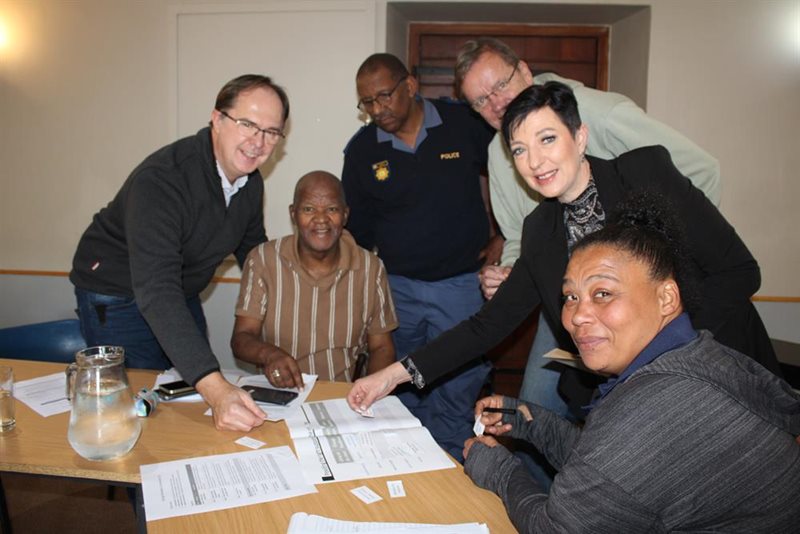
 Riaan Thomson (Department of Environmental Affairs), Jan Horne (Love George), Lieutenant Colonel Lionel Kennedy (Acting Station Commander George Police), Diek Venter (Eden Gemeente), Linda Swanepoel (2nd Hand Sam's) and Estelle Fredericks (George Municipality Community Development). Photos: Michelle Pienaar
‘We bring you the latest Garden Route, Hessequa, Karoo news’