

GARDEN ROUTE NEWS - Nearly half of South African children aged 10 to 17 have tried alcohol, with many starting years before the legal drinking age of 18. Would raising the age to 21 make a difference, or would it become another law that exists only on paper?
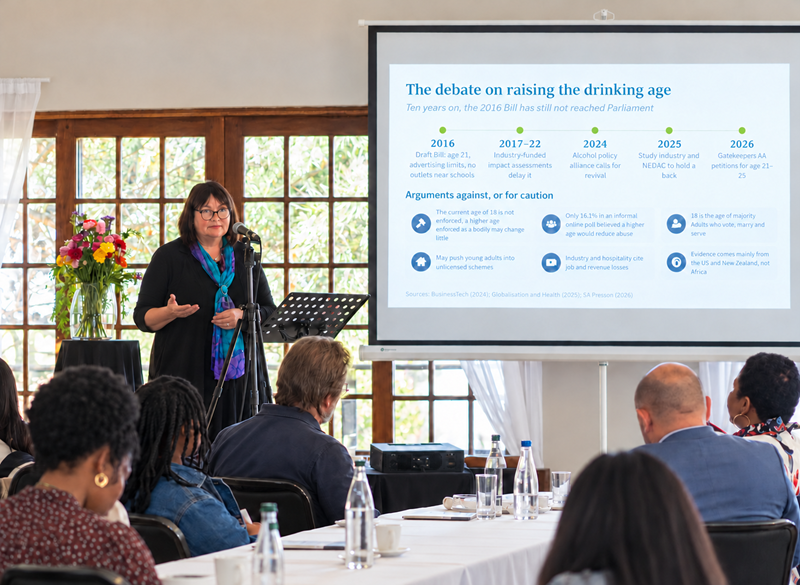
This was the question explored by Prof Marelize Schoeman of the University of South Africa’s (Unisa) College of Law at the Childhood Substance Use, Related Disorders and Mental Health Conference, held at Ilita Lodge in Great Brak River on 30 September and 1 October.
The two-day conference was hosted by Unisa’s College of Law in partnership with the South African National Council on Alcoholism and Drug Dependence (Sanca) national office and Sanca Garden Route.
Schoeman presented research titled ‘Does legal drinking age matter? A cross-national comparative analysis of minimum drinking age laws and childhood alcohol consumption’. The study surveyed 3 566 children aged 10 to 17 across all nine provinces.
She said the figures collected revealed the following:
- Nearly 5 in 10 children (46.4%) have used alcohol at some point, and about 2 in 10 (21.7%) drink now.
- 15% drink weekly and 4.5% daily.
- Children start young. About 1 in 10 children who drink had their first drink before age 10, and 43.1% had it by age 12. The most common age for a first drink is 14.
- Current drinking more than doubles between ages 12 and 13, the year children move to high school.
- More than 2 in 5 children aged 16 and 17 drink now, all of them below the legal age of 18. Among 17-year-olds, the figure is 44.9%.
- Almost 1 in 3 (30.7%) say liquor outlets don’t ask for ID, and 43.4% buy at shebeens or taverns.
- Children drink at parties (45.7%) and family gatherings (36.7%), often with alcohol supplied by older friends.
Because most of these children start drinking years before 18, any change to the legal age would reach them only indirectly.
What the law already says
The current age of 18 is a supply-side rule: it bans selling or supplying alcohol to anyone under 18, but does not make drinking a crime for the child.
Section 10 of the National Liquor Act (2003) applies at home as well as at outlets. Sellers must take reasonable steps to check age, and penalties include a fine of up to R1 million or five years in prison. Provincial Acts, such as the Western Cape Liquor Act of 2008, carry the ban into retail licensing.
There is one loophole. Parents, guardians and people administering a religious sacrament may give a child a “moderate” amount of alcohol under supervision. The Act sets no minimum age for this and doesn’t define “moderate”, which leaves room for abuse.
The 2016 draft Liquor Amendment Bill would raise the age to 21. It would also restrict advertising, ban outlets within 500 metres of schools and places of worship, and make sellers liable for providing alcohol to minors. Ten years on, it still hasn’t reached Parliament. A 2025 study in Globalization and Health argues that early access to the NEDLAC consultation process let the alcohol industry delay and weaken the Bill.
Pressure is building again. In October 2024, the Southern African Alcohol Policy Alliance called for the Bill’s revival. In January 2026, the NGO Gatekeeper South Africa petitioned the President to raise the age to between 21 and 23, ideally 23.
Raising the age to 21 would extend sales restrictions to 18- to 20-year-olds. Children are already covered, so any benefit to them would come mainly from fewer older friends being able to buy alcohol for them.
The enforcement problem
The law at 18 already fails where it meets children, mainly because there is too little capacity to enforce it.
In 2022, Gauteng had 27 inspectors for about 36 000 outlets, and the Eastern Cape had 16 for more than 7,500. By May 2026, Gauteng had fewer than 20 inspectors for more than 33 000 licensed outlets.
In Alexandra and Tembisa, unlicensed shebeens outnumber licensed outlets four to one, completely outside the system that enforces the age.
The HSRC found that outlet owners find fines cheaper than complying with the law, and that paying bribes is common.
Supplying children at home is illegal, yet prosecutions of parents are almost unknown.
The Enyobeni tragedy shows how slowly the law works. In June 2022, 21 young people died in an overcrowded East London tavern; the youngest was 13. In February 2024, the owners were convicted of selling alcohol to a 17-year-old without checking his age, and fined R5 000 each. The inquest named those responsible only in July 2026, four years later.
Crackdowns still tend to follow scandals rather than routine inspection. In December 2025, police began tracing parents only after a viral video showed young children, some under 10, drinking in the Eastern Cape. That same week, Limpopo threatened to revoke the licences of outlets that sell to minors. The researchers ask whether anything would have happened had these cases not reached the media.
THE CASE FOR RAISING THE DRINKING AGE
The strongest evidence for 21 is that it protects young adults; protection for younger children is possible but not guaranteed.
It would cut a supply line. In the 2025 UNISA–SANCA survey, 36% of children got alcohol from friends older than 18. At 21, many of those friends could no longer buy legally.
It would protect 18- to 20-year-olds. This is the best-evidenced benefit. US research comparing young people just before and just after their 21st birthday found that deaths jump by about 9% once they can buy alcohol legally, mainly from road crashes, alcohol poisoning and suicide. Canadian studies found the same pattern. When New Zealand lowered its age from 20 to 18 in 1999, alcohol-related crashes rose among 18- and 19-year-olds, and some studies found more harm among 15- to 17-year-olds too.
It would delay normalisation. After US states moved to 21, high school seniors drank less, and the effect lasted into their early 20s. A higher age also signals to parents, sellers and communities that teenage drinking is not acceptable.
It could make age checks simpler. The gap between a 14-year-old and the youngest legal buyer becomes wider, so it is harder for a child to pass as “old enough”.
It would protect the developing brain, which keeps maturing into the mid-20s. Early drinking speeds the path to dependence.
It follows a regional trend. Ethiopia raised its age to 21 in 2019, and Kenya’s 2025 national alcohol policy sets it at 21. Since 2000, more countries have raised their drinking age than lowered it.
THE CASE AGAINST
The strongest argument against 21 is South Africa’s record with the age it already has.
Enforcement: an age of 21 enforced as badly as 18 may change very little. It would also add three more age groups for the same small inspectorate to police.
Displacement: young adults who can’t buy legally may move to unlicensed shebeens that no inspector visits, the same places where children already drink.
Rights and legitimacy: 18 is the age of majority. People who can vote, marry and serve in the army would be barred from buying a legal product, and a law broken openly by adults teaches everyone that liquor laws are optional. The law would also contradict itself: under the Cannabis for Private Purposes Act, an 18-year-old may grow and use cannabis at home but would be too young to buy a beer.
Public doubt: in an informal Newzroom Afrika social media poll, only 16.1% thought a higher age would reduce alcohol abuse. It is not a scientific sample, but it shows the level of doubt.
The economy: industry and hospitality groups warn of job and revenue losses.
The evidence base: most supporting research comes from the US and New Zealand, which are high-income countries with strong enforcement. No study has evaluated what happened when an African country changed its drinking age.
No new tool for children: a higher age changes nothing in the law for under-18s. They are already fully protected, on paper.
For context, about three-quarters of the 132 countries that report a single national age to the World Health Organization set it at 18, so South Africa is the global norm. Only about 11 countries set it at 21.
The bottom line
A higher drinking age can protect young people, especially 18- to 20-year-olds, but the evidence does not show it will work in a system that cannot enforce the age we already have.
For children, raising the age would probably change little on its own. Laws set standards and give us tools to act, but their effect depends on how well they are implemented, how communities respond, and whether children receive the support they need.
As the researchers put it: “We do not have to wait for a change in the law to strengthen the protection available to children today.”
The question they leave with policymakers, academics and practitioners is what can be done together, now, to reduce children’s access to alcohol and the harm it causes.
‘We bring you the latest Garden Route, Hessequa, Karoo news’