


GEORGE NEWS - A George municipal court prosecutor believes specially trained courthouse dogs could help tackle one of South Africa’s biggest criminal justice challenges: the number of sexual violence cases that never result in convictions.
Groundbreaking research by Megan Hopewell is shedding new light on how these dogs could help vulnerable witnesses during the trauma of testifying.
Her study, believed to be the first of its kind in the country, explores how the dogs could reduce secondary victimisation and help improve outcomes in sexual violence cases.
“Many women I know have suffered some form of gender-based or sexual violence, and most of them never went anywhere near the criminal justice system. That’s what first pulled me into this research. Why do so many of these cases disappear from the process?” says Hopewell.
She then started looking into case attrition, which is the gradual disappearance of complaints.
A national study tracking a year’s reported rape cases found that only 731 out of 3 952 reached trial, and only 340 ended in a conviction. This is set against the roughly 51 000 sexual offences the police recorded in 2024/25.
Hopewell found that secondary victimisation is a major factor contributing to case attrition. “This is what happens when the very process meant to protect survivors ends up harming them again - intense scrutiny, hostile questioning, having to recount the worst moment of their life in front of the accused and onlookers,” she says.
The dog concept
Looking for a way to reduce secondary victimisation, Hopewell turned to an unlikely source. Her research explores the use of trained courthouse facility dogs to support testifying witnesses.
International studies have shown that the dogs help reduce stress and anxiety, enabling witnesses to give evidence more calmly and coherently without influencing their testimony.
Hopewell also came across the Courthouse Dogs Foundation in the United States. This inspired her LLM dissertation, titled “Working Dogs in South African courts aiding vulnerable witnesses during testimony - A solution to attrition?”, which she believes is the first South African study to examine the role of courthouse facility dogs.
Science
This is not just intuition. “Trauma disrupts a witness. It can impair recall, disrupt speech fluency and coherence, and unsettle emotional regulation, causing shame, fear or dissociation that courts too often misread as unreliability or deceit. Interacting with a trained dog counters this directly,” says Hopewell.
“It’s associated with lower heart rate and cortisol, and it triggers an oxytocin response linked to bonding and reduced anxiety. Together, these create a buffered threat response that calms the nervous system so the witness discloses more openly and coherently.”
Success
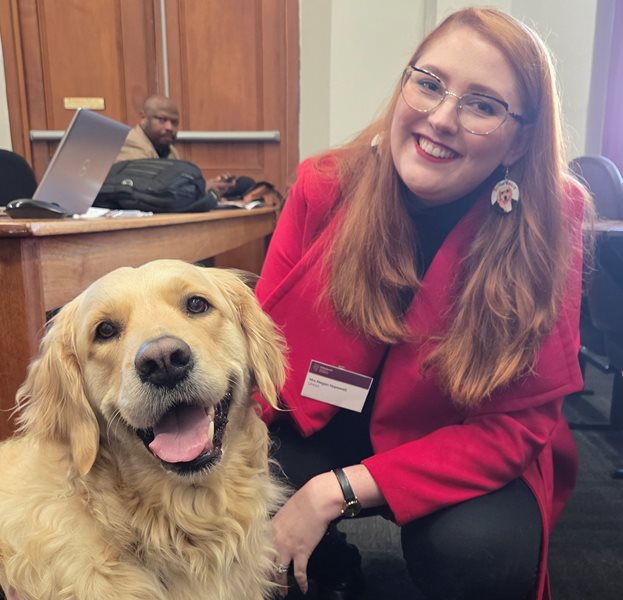
In April this year, something remarkable happened that turned Hopewell’s theory into reality. A dog called Toffee Beanz became the first therapy dog to support a child witness testifying in a South African criminal court.
“She provided a calming, grounding presence that helped the child communicate more clearly under enormous stress. The prosecution succeeded, and the accused was convicted.”
The moment Hopewell heard about it, she reached out to Toffee’s handler, Edith Kriel of the Jelly Beanz Foundation, and they started arranging for the two of them to join Hopewell at the Third Annual Criminal Justice Colloquium at Stellenbosch University’s Faculty of Law earlier this month.
Hopewell was invited to the colloquium after she had co-authored a journal article on her research with her supervisor, Dr Merlyn Barkhuizen. The research was selected for presentation at the colloquium.
“Everyone loved Toffee Beanz. Having her in the room made the argument land in a way that slides and statistics never could. It made it impossible to treat this as a purely theoretical proposal. Her presence was proof that courthouse facility dogs aren’t some distant ideas for our courts, they’re already part of the conversation in South African justice, and I believe it’s time we gave them a proper legal framework,” says Hopewell.
Up to now, Hopewell’s work has been built on international evidence and comparative research, but she hopes to take it further by gathering real, local evidence on how courthouse facility dogs affect survivors and case outcomes in our own courts.
‘We bring you the latest Garden Route, Hessequa, Karoo news’