

Update
GEORGE NEWS - The latest dam level update, supplied by George Municipality on 23 June:
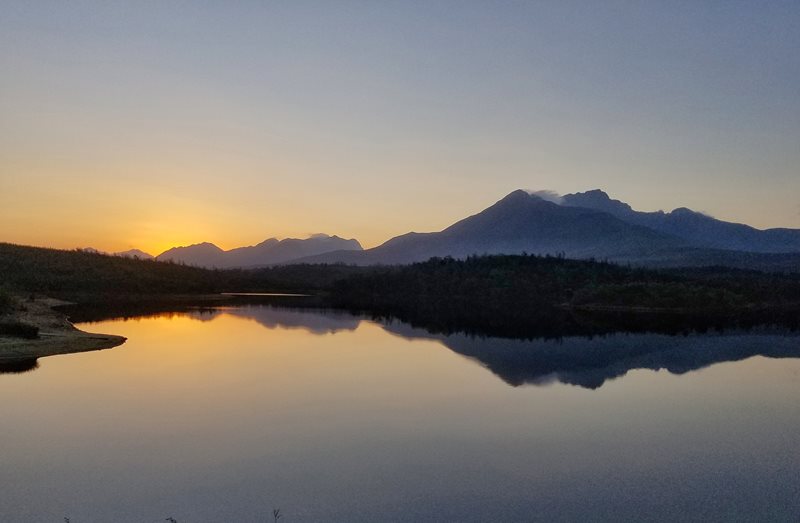
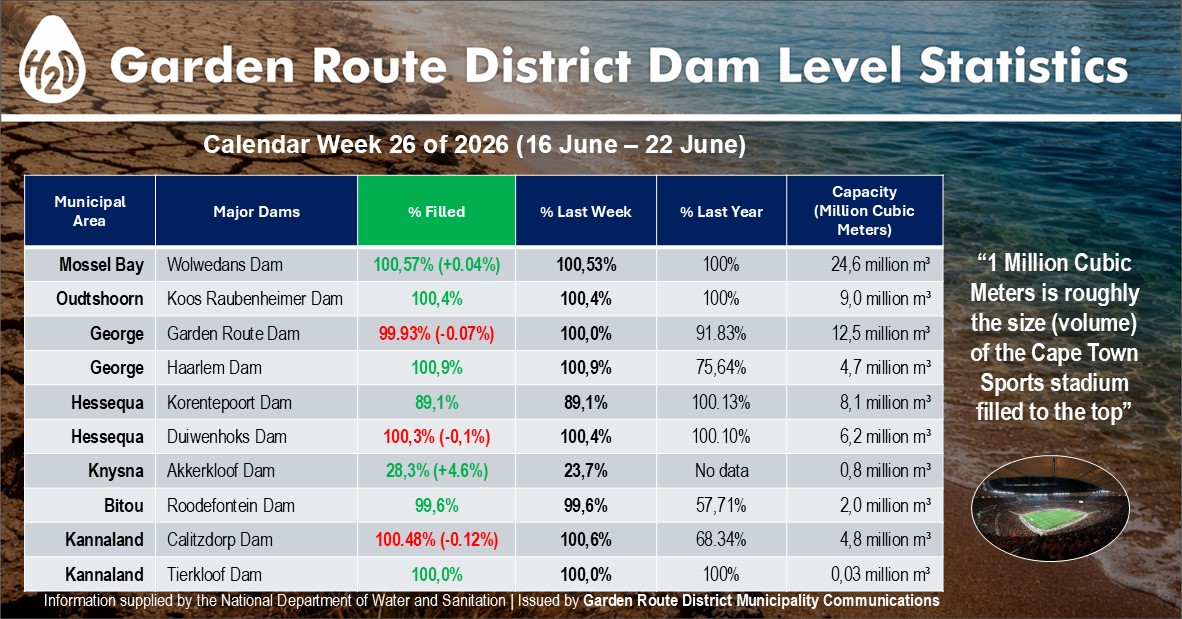
Garden Route Dam Level
- Dam level: 99,93% (Compared to 100% on 17 June)
- Rainfall: 0,8 mm (Measured from 18-23 June)
- Current daily demand: 36.9 million litres/day
- Target daily demand: 36 million litres/day
Haarlem Dam Level
- Dam level: 100,95 % (Compared to 100 % on 17 June)
- Rainfall: 2 mm (Measured from 18-23 June)
Report leaks or misuse:
- 044 801 9262 / 66 | 044 801 6300
- Violations: 044 801 6350 | 044 801 6300
George Municipality has published an updated Frequently Asked Questions (FAQ) document as part of its ongoing Water Conservation Campaign.
The FAQ provides clear information on the current water situation, the recently eased Level 2B Water Demand Management Measures, and the lifting of Level 3 Emergency Water Tariffs.
The document also explains why certain restrictions remain in place despite the recent recovery of dam levels and outlines how residents, businesses, and institutions can continue using water responsibly to protect George's long-term water security.
Residents, businesses, media, and stakeholders are encouraged to read the full FAQ document. For more information on water restrictions and water-saving tips, click here.
Although restrictions have been eased, residents are urged to continue using water sparingly and to avoid unnecessary wastage, particularly as forecasts from the South African Weather Service still indicate the possibility of below-average rainfall during the coming winter months.
The municipality cautioned that, should dam levels decline again as a result of prolonged below-average rainfall, stricter water restrictions and emergency water tariffs may need to be reintroduced in accordance with Council-approved policy and tariff structures.
Frequently asked questions
Level 2B water restrictions - June
1. Why are Level 2B water restrictions still in place if the dams have recovered?
Recent rainfall has significantly improved dam levels and provided welcome relief following a prolonged drought period. As a result, Council eased restrictions from Level 2D to Level 2B and lifted the Level 3 Emergency Water Tariffs.
However, George remains a water-scarce region, and the Municipality must continue planning responsibly for long-term water security. Climate patterns remain unpredictable, and periods of below-average rainfall are still possible.
For this reason, certain restrictions remain in place to encourage responsible water use and to protect available water resources.
2. Why were water restrictions not lifted completely?
Council adopted a cautious approach in line with the Municipal Drought Management Policy.
While dam levels have recovered significantly, the Municipality must continue monitoring dam levels, rainfall patterns, and water consumption trends before considering any further easing of restrictions.
The recent rainfall does not change the fact that George is located in a water-scarce region that remains vulnerable to future drought conditions.
Residents are therefore encouraged to continue using water responsibly and to avoid unnecessary wastage.
3. What changed from Level 2D to Level 2B?
The easing from Level 2D to Level 2B means that some restrictions have been relaxed while important water-saving measures remain in place.
Council also lifted the Level 3 Emergency Water Tariffs with effect from 12 May 2026.
The decision acknowledges the substantial recovery of dam levels as well as the efforts made by residents, businesses, institutions, and visitors to reduce water consumption during the drought period.
4. What water restrictions currently apply under Level 2B?
The following restrictions remain in force:
- Mechanical or automatic irrigation devices and sprinkler systems for gardens are prohibited.
- Gardens may only be watered using a handheld hose during prescribed times and on allocated days according to even- and uneven-numbered properties.
- Irrigation of sports fields remains prohibited, except for golf course greens, bowling greens and cricket pitches during permitted hours.
- Washing of vehicles using a hosepipe is prohibited, except by commercial car wash businesses.
- Cleaning of outdoor surfaces using hosepipes or mechanical means remains prohibited. Buckets may be used.
- Filling of swimming pools is prohibited.
- Properties making use of borehole or reservoir water must display "OWN WATER" signage.
Residents are encouraged to familiarise themselves fully with the approved Level 2B Water Restrictions available on the Municipality's communication platforms.
5. Have the Level 3 Emergency Water Tariffs been lifted?
Yes.
Council resolved on 22 May 2026 to lift the Level 3 Emergency Water Tariffs with effect from 12 May 2026 following the significant recovery of dam levels.
Standard water tariffs now apply.
6. Will my municipal account decrease immediately now that emergency tariffs have been lifted?
Not necessarily.
Some water meter reading routes had already been processed before the effective implementation date of 12 May 2026. As a result, portions of the May 2026 billing cycle may still reflect charges calculated under the previous emergency tariff structure.
Consumers are expected to notice a more significant reduction in water charges on accounts issued during the June 2026 billing cycle, when the revised tariffs are fully incorporated across all billing routes.
7. Can I water my garden?
Yes, but only under the conditions permitted by the Level 2B restrictions.
Automatic irrigation systems and sprinklers remain prohibited. Gardens may only be watered using a handheld hose during approved times and according to the even- and uneven-numbered property schedule.
8. May I fill my swimming pool?
No.
The filling of swimming pools remains prohibited under the current Level 2B restrictions.
9. Can I wash my vehicle using a hosepipe?
No. Washing vehicles with a hosepipe remains prohibited, except at commercial car wash facilities.
Residents are encouraged to use buckets and water-saving cleaning methods instead.
10. Why must properties use borehole water display "OWN WATER" signage?
The signage assists municipal enforcement officials in distinguishing between municipal water use and alternative water sources such as boreholes, reservoirs and rainwater harvesting systems.
This helps avoid unnecessary investigations and supports effective enforcement of restrictions.
11. Will the Municipality continue monitoring the water situation?
Yes. George Municipality continuously monitors:
- Dam levels
- Rainfall patterns
- Water consumption trends
- Long-term water security risks
Any future changes to restrictions or tariffs will be considered in accordance with the Municipal Drought Management Policy and communicated to the public.
12. Is the drought over?
The recent rainfall has substantially improved water availability and dam storage levels.
While the immediate crisis has eased, George remains vulnerable to future periods of below-average rainfall. The Municipality therefore continues to monitor water resources closely and encourages residents to maintain responsible water-use habits.
The Municipality remains committed to long-term water security and the sustainable management of available water resources.
13. How can residents continue contributing to water conservation?
Residents can help by:
- Repairing leaking taps and pipes.
- Avoiding unnecessary water wastage.
- Using water-efficient appliances.
- Limiting outdoor water use.
- Following all Level 2B restrictions.
- Reporting water leaks and misuse.
Responsible water use remains everyone's responsibility.
14. Where can I find more information?
Click here for the latest updates, water restrictions, and water-saving tips.
Previous articles:
- Garden Route Dam is at full capacity
- Relentless rain causes disruption in George, but no major damage reported
- Garden Route Dam level at 90,17%
- Garden Route Dam level rises by 2%
- Water restrictions eased from Level 2D to Level 2B
‘We bring you the latest Garden Route, Hessequa, Karoo news’