


Video
GEORGE NEWS - At least 200 livestock are being kept at Olympia Skills School, including 144 cattle, but the Western Cape Education Department (WCED) is now reviewing the agreement allowing animals to be kept on a portion of the school property.
The livestock are being kept in enclosures, a kraal and other structures at the back on the school grounds.
Two herdsmen who tend to the animals are believed to live in a caravan next to the kraal.
The agreement, which has reportedly been in place for several years, is now under review by the WCED after several concerns were raised about the use of school property, the number of animals being kept there, and livestock wandering into neighbouring residential areas and onto the roads.
Several parents also raised their concerns about their children's health and safety, as the animals often wander into their vicinity.
The Garden Route SPCA confirmed to George Herald that its inspection late in August had found 144 cattle belonging to five different owners, while a further 16 goats and 40 sheep belong to a local minister, Rev Grace Sethosa.
The WCED has confirmed that it is aware of an agreement between the school's school governing body (SGB) and an external party relating to the use of a portion of the school grounds for livestock.
However, the department has not yet determined whether all the necessary governance, approval, safety and legal requirements were followed.
"There is no general prohibition on livestock being kept on school property, but it is subject to strict governance, approval, safety and legal requirements," the WCED's spokesperson, Bronagh Hammond, said.
VIDEO:
The agreement and processes followed at Olympia are currently being reviewed by the district.
Hammond told George Herald that the department was still waiting for the outcome of the review as of 7 September. "I will send our response once review feedback is given," she said.
Cattle on the road
While the WCED's review continues, the presence of the large numbers of livestock on the school's grounds raises a more immediate concern for residents and motorists: roaming animals.
During its investigation, George Herald observed cattle, sheep and goats being kept in enclosures on the school property, as well as a kraal behind the school.
On several occasions, one or two herdsmen were also seen on the premises near the kraal. Some horses were also observed in the vicinity during a recent visit.
George Herald also personally witnessed municipal law enforcement officials shortly after midnight on 12 June chasing a large herd of cattle along Beach Road. The herd was seen moving towards the gravel road between the Pacaltsdorp cemetery and Pick n Pay.
A large herd of cattle was again observed along Olympic Street in Delville Park on the afternoon of 19 June.
The presence of cattle on roads at night is of particular concern, because the animals can be difficult for motorists to see, creating a potentially dangerous situation for both.
Sethosa said the livestock is taken to grazing areas behind Syferfontein and returned to the school property, but concerns remain about animals escaping or wandering into surrounding areas.
The roads in Delville Park are often strewn with heaps of horse and cow dung, forcing drivers to dodge the piles.
 In August, the SPCA recorded 144 cattle belonging to five different owners.
SPCA records 200 livestock at school
Garden Route SPCA branch manager Sue Noakes confirmed that Inspector Henrico Pypers has conducted proactive inspections of the livestock kept behind the school for about five years.
The SPCA said shelters and shepherd accommodation associated with the livestock are situated on the school grounds.
According to Noakes, Sethosa told the SPCA that she had a contractual agreement with the previous school principal permitting her animals to be kept on the school's property.
She also advised that she had provided proof of the agreement to the current principal via email, but had not received a response to her correspondence.
The SPCA stressed, however, that its mandate is specifically concerned with animal welfare and does not extend to determining whether the use of school property complies with education or municipal legislation.
No major welfare concerns
Despite the concerns surrounding the keeping and roaming of the animals, the SPCA said its inspections had not identified major animal welfare concerns.
Noakes said sufficient water was available during the inspections, and the animals appeared to be in fair body condition.
None were found to be injured or diseased, apart from two individual cases in which Sethosa had contacted the SPCA for assistance.
In one case, according to the SPCA, Sethosa arranged and paid for veterinary treatment for a cow suffering from an abscess. Earlier this year, she contacted the SPCA again when another cow was unable to get up.
"The livestock at the school had also recently been vaccinated against foot-and-mouth disease by the state veterinarian," added Noakes.
Roaming animals a separate issue
The SPCA stressed that animal welfare and the problem of roaming livestock are separate issues. Enforcement of municipal by-laws relating to roaming livestock and horses falls under the jurisdiction of George Municipality's Law Enforcement Department, which has the power to impound animals and fine negligent owners.
Noakes said roaming livestock remained an ongoing problem in Pacaltsdorp and Thembalethu.
Horses are also a serious concern. The organisation said it sometimes has to euthanise badly injured animals following such incidents in which animals are struck by vehicles.
The SPCA continues to respond to reports of roaming livestock to check on the animals' welfare and get them off roads and back to safety.
George Herald has sent questions to the George Municipality and followed up, but no response had been received by the time of going to press.
Read the previous comment on roaming livestock at www.georgeherald.com.
Potential health risks
The keeping of livestock close to a school and residential areas also raises potential public health concerns.
Johan Compion, GRDM senior manager for municipal health, air quality and waste management, confirmed that routine inspections are conducted at schools, including Olympia, and that the school had recently been inspected. "There is a risk in terms of diseases and potential health nuisance that can be caused," Compion said.
He said animal waste accumulating in public spaces could create health risks, with bacteria and viruses potentially being transmitted from animals and the environment to people.
Compion clarified, however, that foot-and-mouth disease is not a zoonotic disease and cannot be transmitted from animals to humans.
The management of foot-and-mouth disease falls under the Department of Agriculture and is not a municipal health function.
The GRDM said its records showed that no complaints had been lodged with its Environmental Health division specifically regarding livestock being kept at Olympia Skills School or in the surrounding Delville Park and Syferfontein areas.
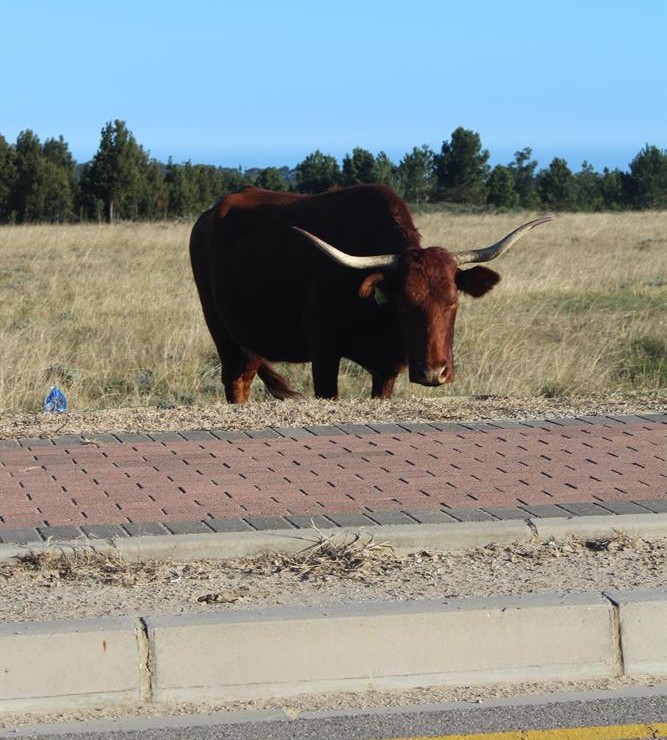 Cattle were seen feeding next to the road.
Sethosa rejects allegations
On Friday 28 August, George Herald encountered Sethosa in the Olympic Street area while photographing some cattle in the vicinity. She confirmed that some of the animals belong to her, but said not all of them.
She undertook to consider a list of questions sent to her, but later declined to respond directly, saying the matter should be investigated by the relevant authorities.
Sethosa accused the newspaper of making "unfounded false allegations" and said she was prepared to respond to any specific allegations referred to her.
She said on that day she had assisted the two herdsmen by providing red lights so that approaching motorists could see when cattle were crossing the road.
Sethosa said she had previously dealt with investigations during her time as a WCED Circuit Manager for Circuit 3 and did not want to be drawn into the process again.
She had resigned from the WCED in March 2023.
‘We bring you the latest Garden Route, Hessequa, Karoo news’