

Video
GEORGE NEWS - George’s water security can no longer depend on the next rainy season. The Garden Route Dam may have recovered to capacity, but rapid population growth, rising water demand, and the threat of prolonged dry conditions continue to put serious long-term pressure on the municipal water system.
George Municipality says it has invested heavily in increasing its ability to treat and distribute water, but it does not intend to impose a blanket moratorium on major new developments based solely on the current El Niño outlook.
Larger developments must instead have enforceable water demand management plans covering measures such as efficient fittings, metering, pressure management, indigenous landscaping and rainwater tanks.
The August 2026 El Niño Southern Oscillation (Enso) outlook indicates that El Niño conditions are expected to strengthen and persist into early 2027. While this does not guarantee drought in George, it remains a significant risk signal.
52% population growth
The numbers tell the story.
According to Stats SA, the George Municipality’s population increased from 193 672 in the 2011 Census to 294 929 in the 2022 Census. That is an increase of more than 101 000 people, or about 52% in 11 years.
George Municipality itself describes the city as one of the fastest-growing in the country, and its latest planning documents put the current population at about 300 000.
Against that growth stands a water system with a history that stretches back more than a century.
From furrows to the Garden Route Dam
Research supplied by the Garden Route Dam Action Group (Gardag), including input from Ken Gie, Muriel Hau Yoon and Pauline Grashoff, traces George’s water infrastructure from the town’s early furrows and reservoirs.
A furrow system supplied George from mountain streams in the 19th century. Gardag notes the construction of the Van Kervel Dam in 1850, followed by the stone Waterhouse reservoir in 1883, when water was piped for the first time.
As George expanded, the Westkloof Dam was completed in 1925. Fourteen years later, the George Dam, also known as the Swart River Dam, was constructed in 1939. It was later raised, but leakage became a problem.
The Garden Route Dam followed during the severe drought of the late 1970s, with construction completed around 1979/80. The George Municipality confirms that it became the city’s main source of potable water.
In 2020, the dam wall and spillway were raised, increasing storage capacity by 25%, from about 10 million cubic metres to an estimated 12.5 million cubic metres.
That intervention bought George more storage, but it did not create an unlimited resource.
Treatment capacity has improved, but demand remains the critical variable
George’s treatment infrastructure has also undergone a major transformation. A R1.115b infrastructure programme has increased municipal treatment capacity to about 60 million litres a day, including a new 20-million-litre-a-day treatment module, according to the George Municipality.
The municipality has also completed a new 40 million litre raw water balancing dam. Together with two existing 30-million-litre facilities, this gives the treatment works 100 million litres of raw water balancing storage.
These are significant engineering improvements. But treatment capacity and water availability are not the same thing.
A treatment plant can only treat water that is available to it. A larger treatment works, therefore, does not remove the underlying vulnerability created by prolonged drought, declining inflows or rising demand.
George’s own planning documents identify the Garden Route Dam as the main surface water source, supplemented by river abstractions from the Kaaimans, Malgas and Touw rivers. Alternative water sources under consideration include treated wastewater reuse, groundwater and desalination.
Desireé du Preez, vice chairperson of Gardag, believes one of the most cost-effective measures to protect George’s water resources would be to intensify the removal of invasive alien vegetation from waterways and catchment areas. She said invasive plants consume significant amounts of water and can reduce the amount reaching rivers and dams. Prioritising alien clearing, particularly along important watercourses, could therefore improve water availability while also protecting the catchment’s health.
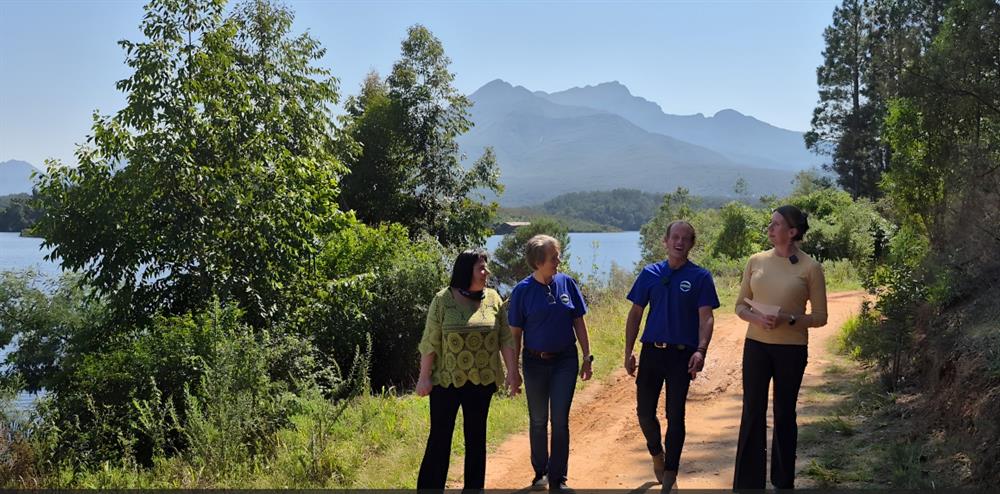 Tracy Pharoah, Desiree du Preez and Brian Cochrane of the Garden Route Dam Action Group in discussion with Marguerite van Ginkel. Photo: Cameron Squire
The drought warning has already happened
This is not theoretical.
In January, the dam stood at about 44.77%, compared with 87.87% a year earlier, prompting George Municipality to request classification of the municipal area as a local disaster area because of severe water shortages. Level 2D restrictions and emergency tariffs were introduced.
Heavy rainfall subsequently transformed the immediate situation. The dam rose from 46.09% to nearly 89% within two weeks, allowing the municipality to ease restrictions from level 2D to 2B and lift emergency tariffs. The dam has since continued to recover and stood at 100% capacity on 15 September.
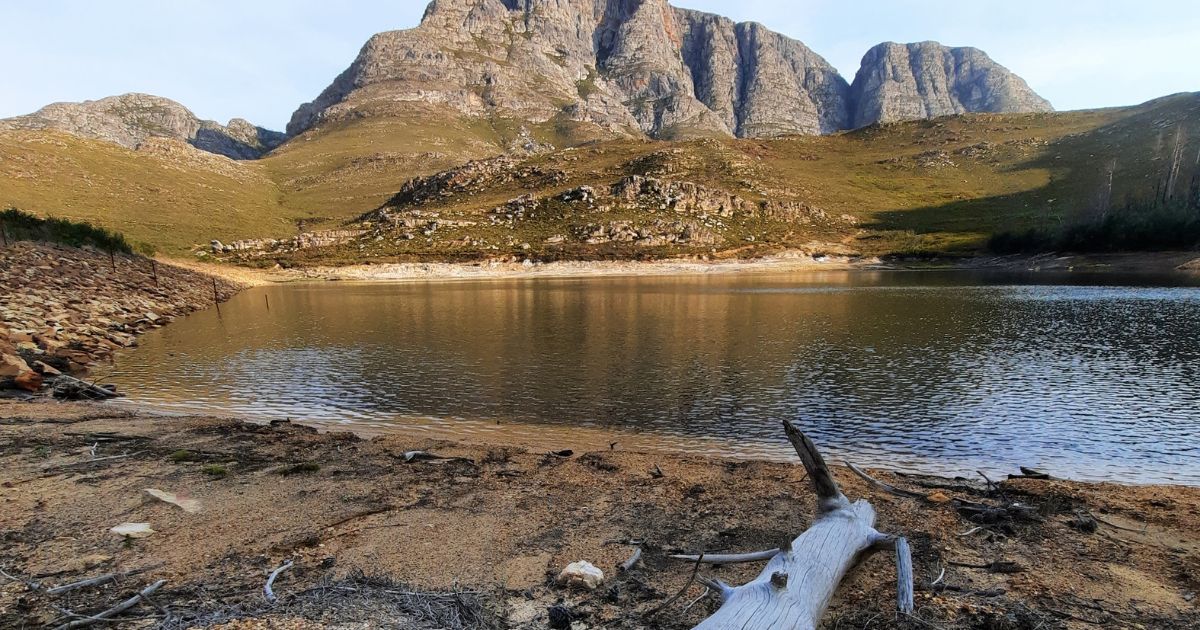 These photos show the fluctuations in the Garden Route Dam’s water levels. Photo: Tracy Pharoah
That recovery should not be mistaken for the problem having disappeared. It demonstrates something more important: George’s water security can change dramatically depending on rainfall and catchment conditions.
Storage starts at home
One of the simplest interventions available to residents is also one of the most overlooked: store water that would otherwise go down the drain.
A household rainwater tank can capture roof run-off for non-potable uses such as gardening, cleaning and toilet flushing, subject to municipal requirements and appropriate plumbing.
Grey water can also be reused, but it must be handled carefully. Shower and bath water can be collected for toilet flushing or other suitable non-potable applications. Water containing faecal matter, harsh chemicals, or unsuitable cleaning products should not be reused indiscriminately.
The arithmetic is compelling.
If 200 000 residents each replaced just one toilet flush a day with water collected from their showers, using an average of 7L per flush, the theoretical saving would be 1.4 million litres of potable water a day.
That is 1.4 million litres that do not have to be abstracted, treated, pumped and distributed as potable water.
It is also why individual behaviour matters, even in a city of almost 300 000 people.
Every litre has a value
Residents can reduce demand by fixing leaking toilets and taps, taking shorter showers, turning taps off while brushing teeth, running washing machines and dishwashers only with full loads, using buckets instead of hoses and avoiding potable water for tasks that can be performed with stored rainwater or other suitable alternative sources.
Gardens are another major opportunity for savings. Indigenous and water-wise plants, mulching and watering during cooler periods can substantially reduce irrigation demand.
And then there is El Niño
The timing deserves attention.
The August 2026 El Niño Southern Oscillation (Enso) outlook from the International Research Institute for Climate and Society shows strong agreement among 26 models that El Niño conditions will strengthen and persist through late 2026 and into early 2027. Almost all models forecast Niño 3.4 sea-surface temperature anomalies above +2°C during August to October.
El Niño does not mean that George will necessarily experience a drought. Local rainfall is controlled by a complex interaction of atmospheric and oceanic systems.
But it is a risk signal that should not be ignored, particularly after George has already experienced severe water shortages in 2025/26.
The lesson from the city’s history is straightforward. George has repeatedly responded to population growth and water shortages by building, raising or upgrading infrastructure. From the furrows and Waterhouse reservoir to Westkloof, the Swart River Dam and ultimately the Garden Route Dam, each generation has had to increase the system’s capacity.
The challenge now is different.
Municipality outlines long-term water-security plans
Jannie Koegelenberg, director of civil engineering services at George Municipality, says the municipality’s long-term water security strategy will rely on a combination of groundwater, water reuse, new storage infrastructure and continued demand management, rather than a single additional water source.
Responding to questions from George Herald about George’s growing population, future water demand, household water storage and the impact of prolonged dry periods, Koegelenberg outlined a range of measures either under way, being investigated or identified for future implementation.
The municipality’s plans include further groundwater exploration, the eventual introduction of indirect potable water reuse at the Outeniqua Wastewater Treatment Works, investigation of a new dam on the Malgas River and continued emphasis on water conservation and demand management.
Outeniqua reclamation plant
According to Koegelenberg, the Outeniqua Wastewater Treatment Works has indirect potable reuse capability and was constructed in 2010 during a severe drought. The facility remains an important potential water security resource.
The municipality is working towards upgrading the facility and introducing additional safeguards to meet international water reuse standards. Implementation could begin around 2030, with the first phase expected to provide about 10 million litres or megalitres (ML) a day as an additional raw water resource. Further expansion could follow at a later stage.
Groundwater exploration
Existing boreholes drilled during the 2009/10 drought are being tested and reactivated as a short- to medium-term measure. A professional hydrogeologist has also been appointed as part of the 2024 bulk raw water resources study to investigate further groundwater opportunities.
Koegelenberg said the first phase of groundwater development is being considered as a high-priority near-term augmentation of about 10ML/d, equivalent to about 3.28 million cubic metres a year. Actual yields will only be confirmed through ongoing testing, geophysical assessments and environmental processes.
A short-term groundwater testing pilot is currently under way, with site establishment for exploration scheduled for October or November, when drilling is expected to start.
Swart River
The municipality does not currently plan further abstraction from the Swart River downstream of the Garden Route Dam, nor does it plan to reinstate the historic Swart River Dam.
The Garden Route Dam is situated on the Swart River. The historic dam is small and leaks, although it is structurally sound, and releases water downstream into the Garden Route Dam. Koegelenberg said the municipality’s existing approved water use licence already includes allocations from the Swart River/Garden Route Dam system.
Malgaskraal Dam
A new dam on the Malgas River has been identified as another potential bulk raw water source. The municipality is in the process of appointing a consultant and specialist consultants to undertake the required investigations.
Koegelenberg said a new dam is a lengthy undertaking from the initial investigations through to construction, with the process estimated to take about eight years. The indicative completion period is around 2034/35.
The 2024 Bulk Raw Water Resources Study identified the following programme for the George system:
• Groundwater phase 1: approx. 3.28 million cubic metres/year, targeted for about 2026
• Indirect reuse phase 1: approx. 1.55 million cubic metres/year, targeted for about 2030
• Malgaskraal Dam: approx. 5.66 million cubic metres/year, targeted for about 2034.
Further phases of groundwater and reuse are also being considered, while desalination remains a longer-term but costly option.
Planning for population growth
George’s rapidly growing population is factored into the municipality’s water demand planning. Koegelenberg said the municipality uses detailed future water requirement models calibrated against historical billed consumption and bulk abstraction data.
The models incorporate population and economic growth assumptions. Municipal planning currently estimates George’s population at more than 310 000, with projected water demand growth of between 2% and 3.5%, adjusted according to actual growth.
Projections extend to 2048/50 under different growth scenarios, including 2% and 3.5% annual growth. Water loss reductions and demand management measures are also incorporated into the projections. The 2024 Bulk Raw Water Resources Study and updates to the Water Services Development Plan are used to guide infrastructure planning against these projected demand trajectories.
Drought and El Niño
The municipality has an approved Drought Management Policy providing for escalating water restrictions and emergency tariffs.
Koegelenberg said dam levels, inflows and consumption are actively monitored, with the relevant drought management and emergency tariff levels implemented in response to dry conditions and increased scarcity. The 2024 study, together with ongoing operational modelling, assesses the system’s yield under variable rainfall conditions.
 Photo taken during a recent drought. Photo: Tracy Pharoah
Water storage at household level
Household water conservation is regarded as an important component of the municipality’s Water Conservation and Water Demand Management Strategy.
Rainwater-harvesting tanks are compulsory for new buildings, typically with a capacity of 5 000L, or a minimum of 2 500L where site constraints apply. The municipality also strongly encourages existing property owners to install tanks, with simplified approvals and fee waivers during restriction periods. Harvested rainwater is intended primarily for non-potable uses, including irrigation, laundry, toilet flushing, car washing and cleaning hard surfaces.
Koegelenberg said grey water reuse on private properties is generally not actively promoted because of health and practical considerations. Municipal indirect potable reuse and larger controlled reuse facilities managed by private developments are, however, regarded as important longer-term options.
He said household demand management measures remain highly important, because effectively managing and reducing consumption and water losses is one of the most effective forms of long-term resource planning.
Development during dry periods
As stated, George Municipality does not intend to impose a blanket moratorium on major new developments based solely on meteorological predictions such as the current El Niño outlook.
According to Koegelenberg, natural weather phenomena have occurred throughout history and will continue to occur, and the municipality must position itself to manage the resulting disasters.
Instead, the municipality’s approach is to ensure that new developments are supported by responsible infrastructure planning and appropriate water demand management measures.
Larger new developments must have an enforceable Water Demand Management Plan, which can include water-efficient fittings, metering, pressure management, indigenous landscaping and compulsory rainwater tanks. These requirements become obligations for homeowners.
According to Koegelenberg, development approvals are therefore aligned with longer-term infrastructure planning rather than short-term weather forecasts. The municipality’s approach is focused on demand management, progressive augmentation of water resources and ensuring that growth does not exceed licensed or planned capacity.
On-site water reuse is also becoming increasingly evident in larger new developments.