

GEORGE NEWS - Part of George Municipality's contingency plans for a situation in which the Garden Route Dam's supply does not outlast the drought, is to commission the boreholes it had developed during the 2009/10 drought.
The Civil Engineering Department's deputy director for Water Services, Deon de Jager, says as part of a bulk water resource study that was concluded in 2024, the George Municipality appointed a professional groundwater geohydrologist to assist it with short, medium and long-term groundwater development.
Part of the short to medium-term planning and implementation is to test the existing boreholes.
"Three of the boreholes will be commissioned before the end of December. The yield capability of the existing groundwater scheme will be tested and confirmed by the geohydrologist as the project progresses. Long-term groundwater development includes additional boreholes upon recommendation by the geohydrologist, following the geophysical assessment."
The level 2C water restrictions announced on 4 December are part of the municipality's measures to manage water demand and safeguard supply.
"These restrictions are designed to significantly reduce consumption, manage abstractions and delay or prevent a worst-case scenario."
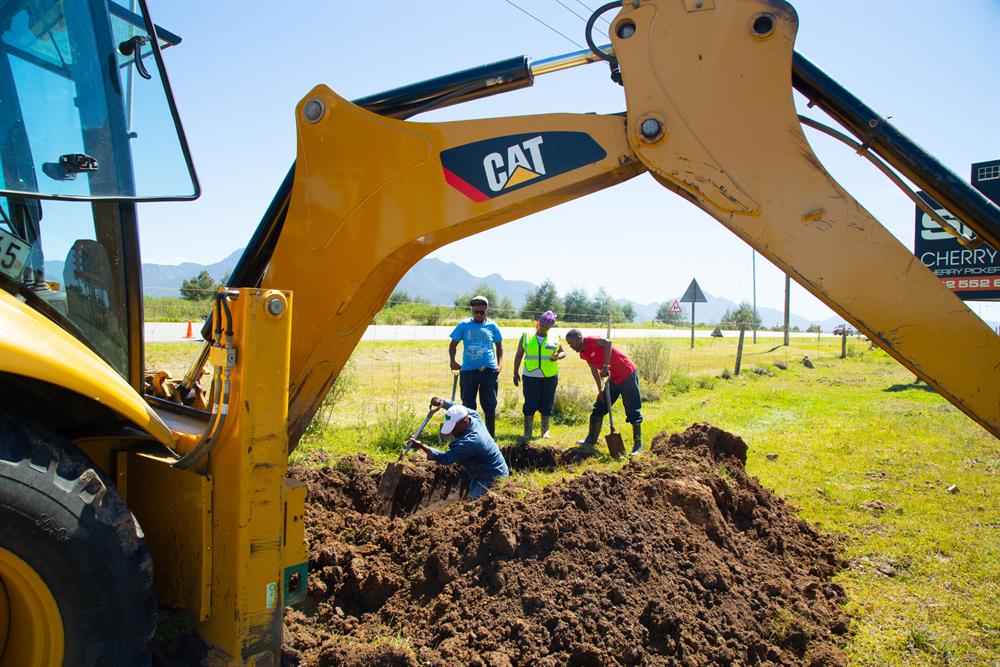
 A broken pipe being repaired. Photo: George Municipality
In times of drought, private property owners also turn to groundwater sources. George Herald has learnt of a resident who recently sunk a borehole on their property.
De Jager says private boreholes and well points within the municipal area are governed by the municipality's Water and Sanitation By-law. In terms of this by-law, the municipality may require the owner/occupier of a property to notify it on a prescribed form of the existence of a borehole. Where someone intends to sink a borehole or well point, the municipality must be notified before the work starts.
Information that would be required (for existing and intended boreholes) includes stating the aquifer into which the borehole is drilled, the final depth drilled, and ideally, the driller's log or comments. An environmental impact assessment may also be required beforehand.
According to the requirements of the National Water Act, 1998 (Act No 36 of 1998), water supply from a borehole or well point may not be connected to a water installation that is connected to the municipality's water supply system. This is a health risk to other consumers, as the water from the municipal system complies with SANS 0241 standards, and the borehole may not. A separate system must therefore be installed for the use of the borehole water.
"The owner of the premises on which water supply from a borehole or well point is used for human consumption must ensure that the water quality complies with SANS 0241 standards. The municipality will not be liable for any loss or damage due to health-related incidents where boreholes or well points are used," says De Jager.
‘We bring you the latest Garden Route, Hessequa, Karoo news’