

Update
GEORGE NEWS - The sentencing in the case of Uniondale farmer André Barnard, who was convicted over the death of a leopard caught in a cage trap on his farm, has been postponed to Wednesday 7 October.
Barnard was due to be sentenced in the Thembalethu Regional Court today, Thursday 20 August, as the State was still awaiting a probation report.
A correctional supervision report had already been obtained. The court was informed that the probation report is expected to be ready by mid-September.
Barnard was not present, as the State had grant him permission to be absent.
The court was also handed an application by Dr Bool Smuts of the Landmark Foundation, who is seeking leave to make submissions at sentencing in the public’s interest. The magistrate, however, said it could not be accepted before it had been formally placed before and accepted by the court.
The State also advised that they will not use such a witness statement from Smuts.
The defence has received a copy of Smuts’ application in an email in the meantime.
Read Smuts’ application here:
LANDMARK FOUNDATION NOTICE OF APPLICATION FOR LEAVE TO MAKE SUBMISSIONS AT SENTENCING, AFFIDAVIT AND ANNEXURE.pdf
The magistrate indicated that the court would first need an opportunity to consider the application before it could be dealt with. No ruling was made on the application on Thursday.
In a press release following court proceedings, the Foundation said its purpose in seeking to make the submission was to ensure that the court was properly informed of the conservation significance of the offence and the broader implications for the protection of threatened and protected wildlife.
“The foundation respects the court’s authority to determine what evidence and submissions are properly before it.
“However, the refusal to receive the foundation’s Section 274(1) submission means that an organisation that has followed this prosecution for six years and has specialist knowledge of the conservation implications has not been afforded the opportunity to place those submissions before the sentencing court in the manner sought,” the statement read.
Background
Barnard, of Toorwater Farm on the southern slopes of the Swartberg, was found guilty on six charges relating to the illegal trapping and death of a leopard.
The charges stem from August 2020, when the leopard was caught in a cage trap on the farm and subsequently died after being left without food or water.
Barnard, who initially pleaded not guilty, was convicted under the Western Cape Nature Conservation Ordinance and the Animals Protection Act.
According to Smuts, Barnard had caught the leopard in the trap and knowingly left it there to die of starvation and dehydration instead of shooting it or calling for assistance.
“Barnard allegedly wished it dead, but did not want to shoot it. Nor would he call CapeNature or the Landmark Foundation for assistance. Instead, it was left to die in the cage,” Smuts said.
It is not known exactly how long the leopard suffered before dying. “Dying of dehydration, by deprivation of water, is the cruellest death any animal can be subjected to,” Smuts said.
He said reasonable alternatives had been available to the farmer that could have saved the leopard.
The Landmark Foundation says it has monitored the case since April 2022, attending 19 court appearances and corresponding with the National Prosecuting Authority regarding the applicability of the Animals Protection Act, the National Environmental Management: Biodiversity Act (Nemba), the Threatened or Protected Species Regulations (Tops Regulations) and the National Environmental Management Act (Nema).
Landmark wanted its ecological, animal welfare and regulatory submissions to be considered by the court alongside the probation and correctional supervision reports when sentencing takes place. The matter returns to the Thembalethu Regional Court on 7 October,
The legal framework
The case has also brought the rules governing the capture of protected wildlife into focus.
Under the Western Cape Nature Conservation Ordinance, hunting includes capturing or attempting to capture a wild animal.
A permit or licence is generally required to hunt a protected wild animal, while trapping is a prohibited hunting method for which a special permit is required.
The definition of a trap includes a cage, snare, gin or spring trap.
Leopards are protected wild animals in the Western Cape, meaning their capture or hunting is subject to conservation legislation and the appropriate permits.
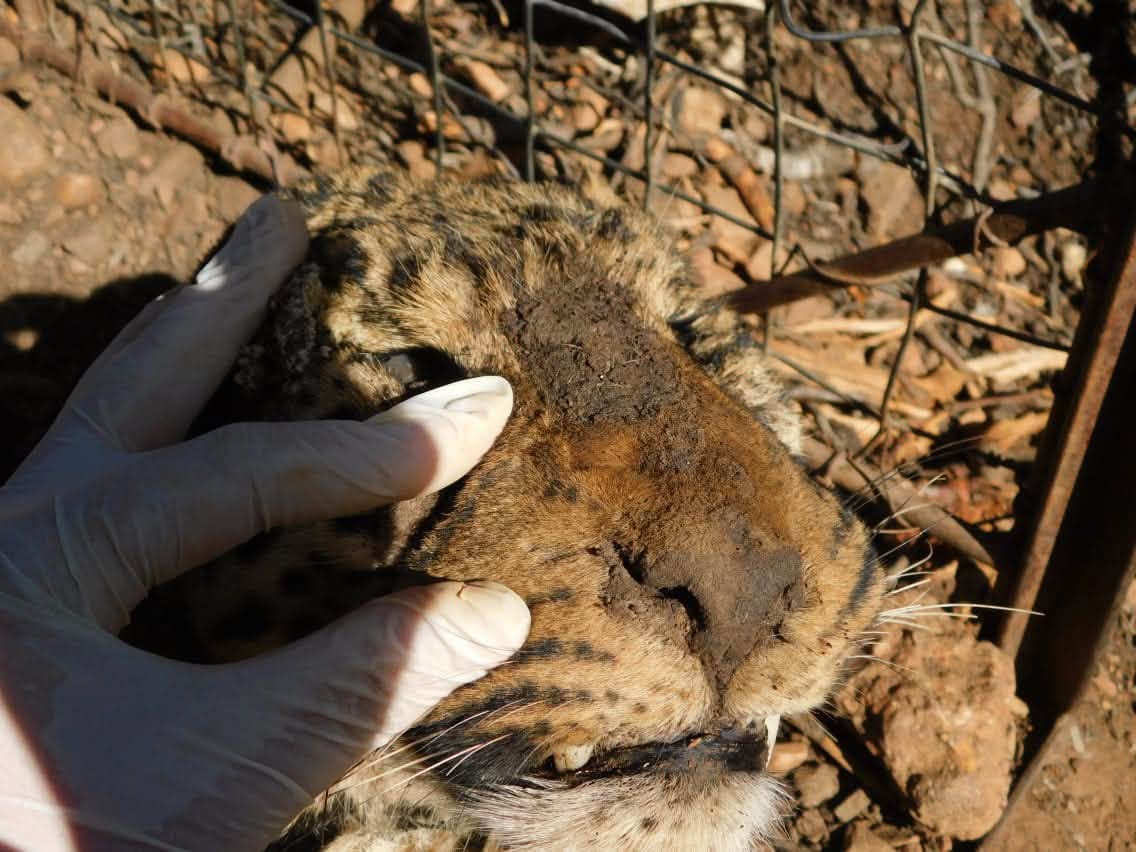 The leopard died of thirst and hunger. Photo: Supplied
Previous articles:
‘We bring you the latest Garden Route, Hessequa, Karoo news’