

ENVIRONMENTAL NEWS - September is Arbor Month, a time to celebrate trees, but also an opportunity to pause and reconsider the extraordinary role they play in our lives.
Conservation does not begin somewhere far away in a nature reserve. Conservation starts at home.
If we want our planet to remain a safe and liveable place for every living creature—including ourselves—we need to understand that biodiversity is not something separate from us. We are part of biodiversity. We depend on it.
Without trees, insects, birds, fungi, soil organisms and the countless other forms of life that make up healthy ecosystems, our own survival is ultimately threatened.
This is particularly relevant in George following the devastating storm of 11 May, which resulted in the loss of more than 4,000 trees across the city. While many of those trees were alien species, their loss has nevertheless changed the urban environment and removed years, and in some cases decades, of ecological services.
It is therefore time to think carefully about what we plant and what we remove.
At Landmark Rewilding, we encourage residents to plant native trees, shrubs and plants in their gardens wherever possible. Native plants provide food, shelter and habitat for our indigenous insects, birds and other wildlife. By choosing plants that belong to this landscape, we can turn our gardens into small but meaningful refuges for biodiversity.
But there is another important principle we need to recognise: every tree that is already part of our urban landscape has value.
Our cities are no longer purely natural environments. They have become what ecologists describe as anthropogenic biomes - ecosystems profoundly shaped by human activity. Within these environments, trees that may not originally have occurred here can nevertheless become part of the ecological system.
An old oak, pine or other non-invasive exotic tree may have been standing in George for 50, 80 or even 100 years. During that time, birds have nested in it, insects have lived on it, fungi have colonised it, shade has been created beneath it, leaves have enriched the soil, and generations of people and wildlife have benefited from it.
That tree has become part of our urban ecosystem.
This is why we should think very carefully before removing a mature tree simply because it is not indigenous - or because someone wants an uninterrupted view of the Outeniqua Mountains.
Consider an 80-year-old tree. For perhaps 60 years of its life it may have been providing habitat, shade, carbon storage, cooling, soil protection and food for wildlife. Removing it and planting two or three young trees is certainly better than replacing it with nothing. But we must not pretend that the ecological value is equivalent.
It isn't.
A young tree cannot immediately replace a mature tree. It may take decades before it provides comparable canopy, nesting sites, shade, carbon storage and habitat.
Planting new trees is essential. But protecting mature trees is equally essential.
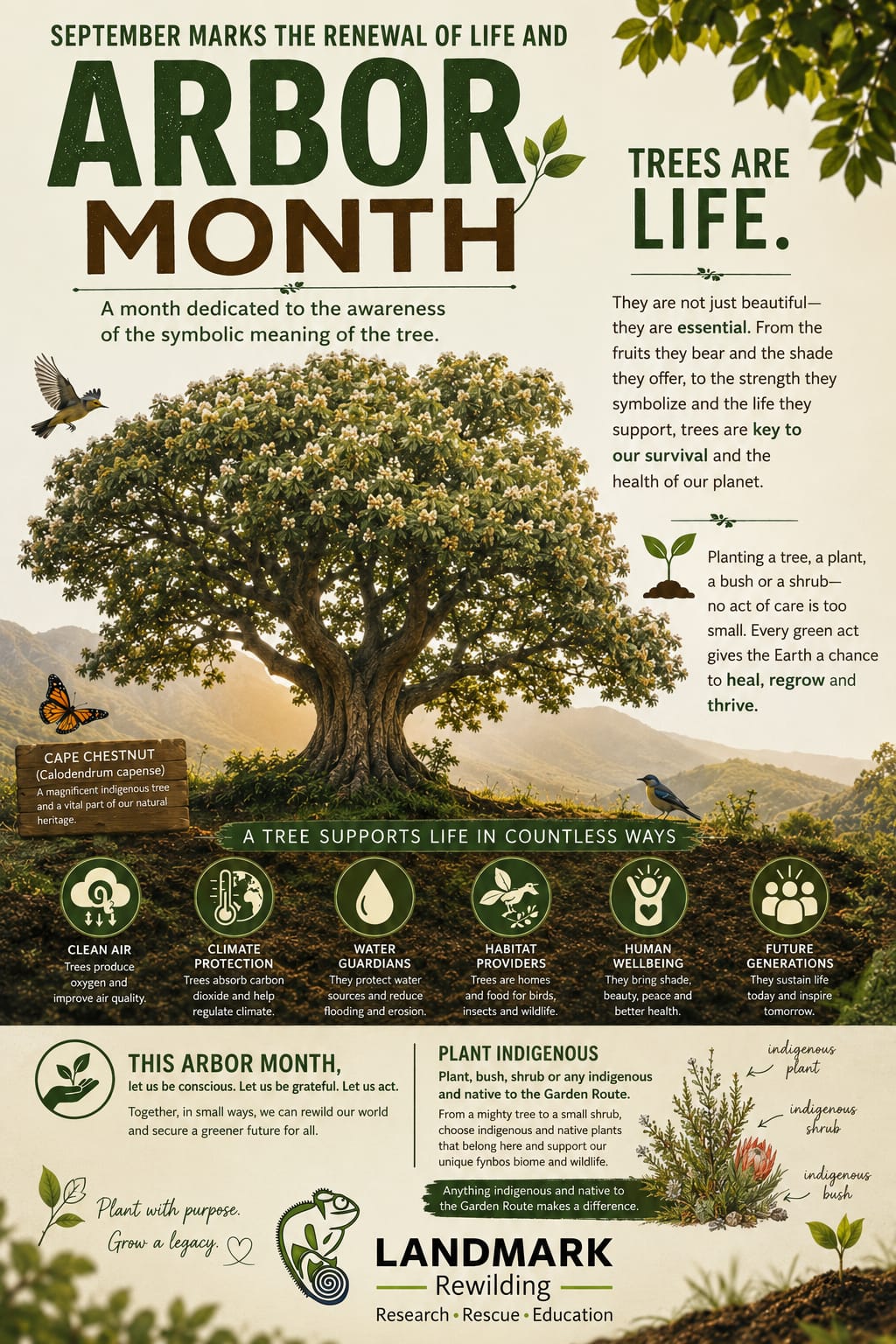 Poster supplied by Landmark Rewilding.
We also need to reconsider the increasingly common response of removing an entire tree because one branch has broken during strong wind. Trees, like every living thing, carry some risk. But removing an entire mature tree because a branch has fallen is not necessarily a rational response.
We do not remove every car from our roads because cars cause accidents. We assess the risk.
Trees should be treated in the same way. Where possible, we should assess, prune, manage and monitor trees rather than automatically remove them.
And when a mature tree genuinely has to be removed, we should acknowledge the ecological loss and compensate for it by planting new trees - ideally several, and preferably native species suited to the landscape.
Arbor Month should therefore be more than a month of planting trees. It should be a month of changing the way we think about them.
Look at the trees in your own garden. Before removing one, ask what it has been providing. Who lives in it? Who feeds from it? What shade does it create? How much carbon has it stored? How much water does it intercept? How long would it take a replacement tree to provide the same services?
Then plant something native.
Plant for the birds. Plant for the insects. Plant for the soil. Plant for the future.
Because conservation is not only about protecting distant wilderness. It is about recognising that the living world is all around us—and that our own survival is inseparable from its survival.
Conservation starts at home. And sometimes, it starts with simply choosing to leave an old tree standing.
‘We bring you the latest Garden Route, Hessequa, Karoo news’