

OPINION - In the first instalment of our new Business Unplugged series by local expert Prof Adéle Potgieter, she unpacks a critical but often overlooked concept: business identity.
More than just a logo or slogan, identity defines who you are, what you stand for, and why your business matters.
Marius has been running his hardware store in George for 11 years. Ask him what he sells, and he will answer without hesitation. Ask him why someone should choose his store over the new chain that opened on the N2 last year, and he goes quiet. He knows the answer somewhere inside him. He has just never put it into words.
That silence is costing him customers every week.
Business identity is not a marketing exercise. It is not a logo refresh or a new tagline. It is the answer to the most fundamental question any business owner can ask: who are we, and why does it matter? And it is the question most small business owners never take the time to answer properly.
Your brand already exists, whether you built it or not
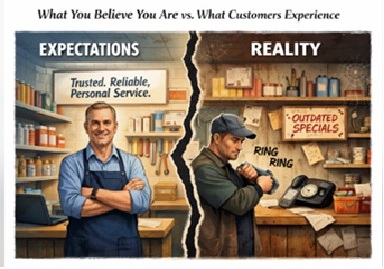
Here is something that might surprise you: your business already has a brand identity. Your customers already have a clear impression of who you are. The only question is whether that identity was built deliberately - or whether it formed by accident while you were busy running the business.
Brand identity operates on three layers. The first is your intention - and this is where your brand lives. Your business name, your logo, your slogan, your stated values, your purpose - these are not cosmetic choices. They are signals. They tell the market what to expect, what you stand for, and why you exist.
When they are clear and aligned, they position your business. When they are vague or inconsistent, they create confusion before you have even served your first customer.
The second layer is your image - the impression your customers actually form, based on every interaction they have with you. What they see, hear and experience either reinforces your brand identity or quietly contradicts it.
The third is your integrity - the alignment between what you say you are and what customers experience. This is where trust is built - or lost.
Most small businesses underestimate the power of the first layer. They have a name, but it says nothing. A logo exists, but it communicates little. In many cases, there is no slogan at all - no clear statement of what the business does or why it matters.
The result is predictable: the owner believes the business is friendly, reliable and professional, but the customer experiences a rushed phone call, a late invoice, and an outdated online presence.
That gap - between what you intend and what people experience - is where customers quietly walk away.
The three questions that define you
Business identity is not a branding exercise you get to later. It is the core of your business - the thing that determines whether customers choose you, trust you, and come back.
What do we actually do and for whom?
Not the technical answer. The real one. A plumber fixes leaks. But a plumber who specialises in emergency calls for elderly homeowners in George is not fixing pipes - he is providing peace of mind to people who cannot manage a crisis on their own. That is a completely different business in the eyes of the customer. It is clearer, more valuable, and far harder to replace. If your answer sounds like everyone else in your industry, your brand is already invisible.
Why does it matter?
What would genuinely be lost if your business disappeared tomorrow? If the honest answer is “not much - someone else would step in”, then you do not yet have a brand. You have a service. Brands exist where there is meaning, not just function.
What do we believe about how business should be done?
This is where most businesses weaken their identity. Values are not what you write down - they are what you consistently do. They show up in the uncomfortable moments: when a client complains, when a mistake costs you money, when no one is watching. This is where your brand either becomes real or falls apart.
Together, these three answers do more than define your identity - they determine your position in the market. Businesses that answer them clearly build trust, loyalty and pricing power. Businesses that avoid them compete on convenience and cost, and are easily replaced
Why consistency is the only proof that counts?
Identity without consistency is just intention. And customers do not pay for intentions - they pay for experiences.
Consider a guest house in Wilderness that markets itself as a warm, personal, family-run escape. The website is beautiful. Instagram is thoughtful. But when a guest arrives, the owner is not there, the room has not been properly prepared, and breakfast is a packaged muffin from the garage down the road.
The guest leaves a two-star review not because the place was awful, but because it was not what it promised to be.
Consistency does not require perfection. It requires honesty. If your business is small and sometimes stretched, own that. Position it as personal and attentive rather than slick and corporate. Then deliver on that promise every single time.
Identity as a decision-making filter
Here is the most practical use of a well-defined business identity: it makes decisions easier.
Consider a small plumbing business called SafeHome Emergency Plumbing. The name already tells you who it is for. The logo features a simple house icon with a shield - signalling protection, not just repair. The slogan reads: “Peace of mind when it matters most.”
This is not decoration. It is direction.
When a client calls and pushes for a 30% discount, the decision becomes clearer. This business is not positioned as the cheapest option - it is positioned around trust, urgency and reliability. Discounting heavily would contradict the promise it has made. The answer is no - not because of pricing policy, but because of identity.
When interviewing a highly skilled technician who speaks dismissively about previous employers, the decision is just as clear. A business that promises ‘peace of mind’ cannot deliver that through someone who undermines trust. Again, the answer is no - because the brand has already defined the standard.
This is what a strong identity does. It moves decisions out of the moment and anchors them in something consistent.
Identity does not give you all the answers. But it gives you a filter - one that is built into your name, your logo, your message, and your values. And a business that knows who it is makes faster, clearer, more consistent decisions than one that is figuring it out on the fly every time.
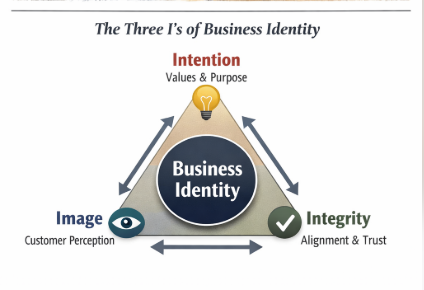
The three Is of identity
- Intention: The values and purpose you choose to stand for. This is the identity you build from the inside out.
- Image: The impression your customers actually have of you, based on everything they experience. This is the identity they live with.
- Integrity: The gap - or the alignment - between the two. A business with integrity is one where Intention and Image are one and the same.
This week’s exercise: Your one-page identity
Set aside 30 minutes - not at your desk in the middle of a working day, but somewhere you can think.
Answer these four questions in one sentence each:
- What does my business do - and for whom specifically?
- Why does it matter? What would be lost if we did not exist?
- What do we believe about how business should be done?
- Does my business name, logo and slogan communicate what I want to do as a business?
Then ask a loyal customer the same questions about you. Compare their answers to yours.
Where they match, you have integrity. Where they differ, you have work to do.
• Look out for the next column: Once you know who you are, the next step is knowing exactly who you are for.
Read more Opinion pieces here.
‘We bring you the latest Garden Route, Hessequa, Karoo news’