


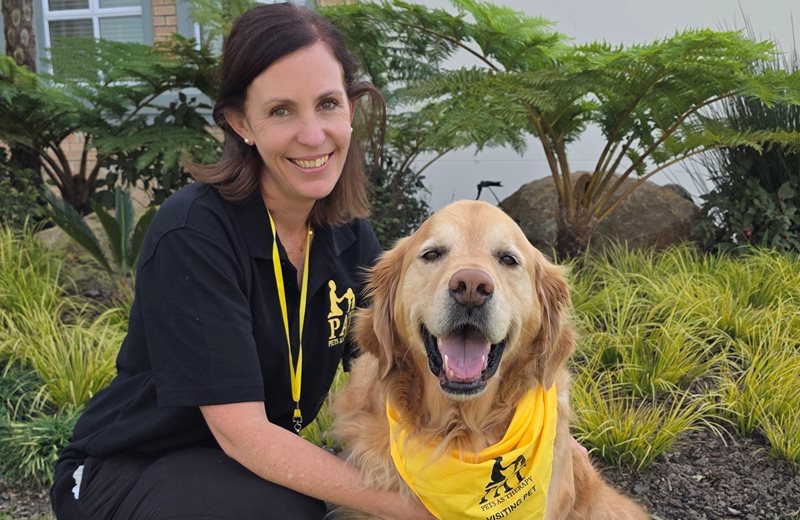
GEORGE NEWS - For a child who freezes when asked to read aloud in class, the fear is rarely about the words themselves. It's about being watched and corrected.
Charlie, a golden retriever, offers something no teacher, parent or classmate can: an audience that never judges.
According to his owner, remedial teacher Jenna Harbottle, Charlie is currently the Garden Route's only registered therapy dog working as part of the Reading Education Assistance Dogs (READ) programme.
His job is to quietly lie on the floor while struggling young readers work through a book at their own pace, with nobody keeping score. Harbottle got Charlie as a puppy nearly six years ago with this purpose in mind.
However, life got in the way, and it was only after she had left her preschool post to return to full-time remedial teaching that she finally pursued it, putting Charlie through an assessment with Pets as Therapy (PAT), the South African organisation affiliated with the international READ programme run by Intermountain Therapy Animals.
PAT is a community-based, voluntary organisation that places animals and their companions, mostly dogs, in care, education and residential settings across the country.
Animal visits offer companionship, comfort and stress relief, and research is showing the benefits of human-animal contact.
It's all about temperament
Harbottle says Charlie's assessment was not about tricks or intelligence. "A PAT assessor watched how Charlie coped with the kind of chaos a real session might bring. What they were looking for was temperament rather than training," she says.
Beyond his early obedience work, Charlie has had no specialised training for the role. Calm, unbothered and clearly fond of children, he passed with flying colours.
"Reading to an animal removes two things: an audience and the fear of being corrected. Stroking a dog has also been shown to lower blood pressure and release oxytocin."
She points to research from roughly a decade ago comparing children who read to an adult, a dog alone, a dog with an adult present and a control group with no reading partner.
"Over a 10-week programme of weekly 20-minute sessions, the children who read to a dog improved the most and were still ahead of the other groups when tested again eight months later," she says.
In practice, that means a quiet room, a rug and a big, unbothered dog.
Harbottle currently runs her sessions from a space lent to her by Glenwood House. Children are referred by the school's remedial support staff or teachers who have identified pupils falling behind. With parental consent, she has also taken on children from outside the school.
The reading work falls under PAT's Lees-Ukufunda-Read programme, an additional leg for existing PAT members who want to help children. During sessions, children sit and read to their animal companion.
PAT dogs can also visit retirement homes, hospitals and other settings, something Harbottle hopes to explore with Charlie in future.
‘We bring you the latest Garden Route, Hessequa, Karoo news’