

OPINION - We are currently celebrating National Water Week. But what does that mean for us?
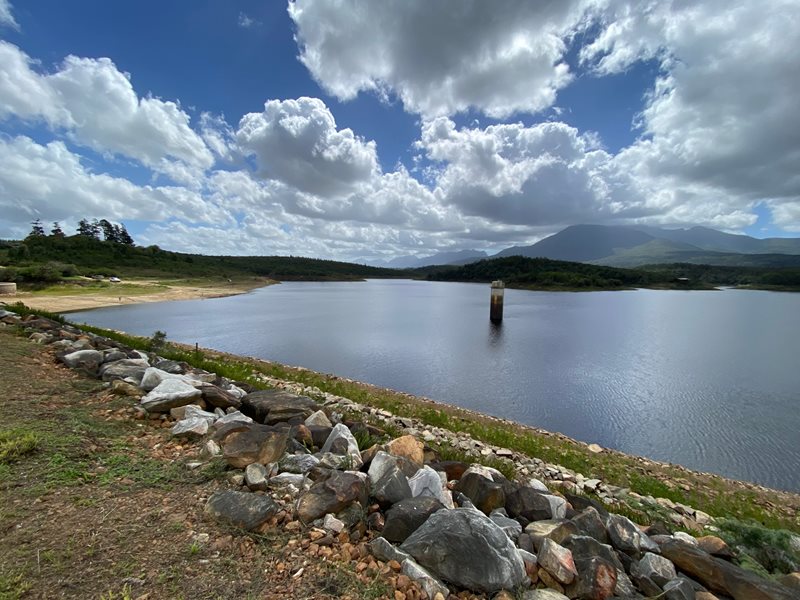
Here I was, sitting on my stoep, sipping something refreshing whilst looking at the stupendous Outeniqua Mountains, the ever-changing cloudscape, with a casual glance at the various weather apps on my clever phone, and … not seeing or feeling the promised rain!
None of this is new. We live in a water-scarce country. And, like elsewhere in the world, there is too much or too little of this life-preserving substance. How much water do we have?
George is essentially dependent on a single source of rainwater, aggregated in the Garden Route Dam, supplemented with small volumes of water from the Malgas and Kaaimans Rivers. The George Municipality 5th Generation Integrated Development Plan (2022–2027) indicates that the yield of the Garden Route Dam – the water that it can supply – is ≈ 5.8 million m³ per year.
George’s population has grown to 294,929 persons, or 85,931 households, according to the 2022 StatsSA figures, with an annual growth rate of 4%.
The billed consumption (2023/24) is ~8.5 million m³/year, and the annualised average daily demand (AADD ~32 ML/day) is 11.7 million m³/year.
The reality is that the dam can only supply about two-thirds of actual billed use, or half of the total water demand of George. This means that the Garden Route Dam alone cannot meet George’s annual demand.
The citizens of George are facing water bankruptcy. The International Union for Conservation of Nature (IUCN) defines water bankruptcy as the point at which water demand permanently exceeds sustainable supply within a river basin or aquifer. In finance, that is insolvency. In water management, it is systemic over-commitment.
The uncomfortable truth is this:
We cannot “develop” our way out of a hydrological deficit. New infrastructure cannot create water where long-term yield is already exceeded. The only sustainable correction to water bankruptcy is embedding hydrological reality into future development planning.
That means:
- Approving new developments only where verified surplus yield exists
- Requiring water availability certification before land use approval
- Aligning spatial planning frameworks with catchment yield limits
- Phasing growth according to confirmed supply augmentation — not projected demand
Rejecting applications that rely on over-allocated or stressed systems - Future growth must be planned within the limits of the water budget — not beyond it
The question remains whether our municipality is willing to plan within it. Desireé du Preez
George Municipality responds:
George Municipality acknowledges the concerns raised regarding water availability and long-term sustainability, particularly during National Water Week 2026, a time dedicated to reflecting on responsible water use and conservation.
George, like many parts of South Africa, is experiencing the effects of prolonged below-average rainfall and increasing demand driven by population growth. While it is correct that the Garden Route Dam remains the primary source of supply, it is not the sole component of the town’s water system. The municipality supplements supply through additional sources, including the Kaaimans and Malgas river systems, and continues to investigate further augmentation options.
The characterisation of George as ‘water bankrupt’, implying a permanent exceedance of sustainable water supply, is not accepted.
While the municipality is operating under significant water stress due to drought conditions and demand pressures, the situation is actively managed through multiple water sources, demand management interventions and long-term planning, and does not constitute structural or permanent insolvency of the water system. Current challenges are the result of a combination of drought conditions, demand pressures, and system constraints, rather than a permanent exceedance of sustainable supply. Importantly, water demand management measures are actively in place to ensure that available resources are used responsibly and efficiently.
The municipality has implemented Level 2D Water Demand Management Measures, alongside Level 3 Emergency Water Tariffs, to curb consumption and extend available supply.
Infrastructure interventions, such as pressure management, leak detection, and the installation of water-saving devices in municipal facilities, form part of a broader strategy to reduce demand.
Long-term planning
In addition, long-term planning remains a priority. All development applications are assessed in line with available bulk infrastructure capacity, and water availability is a key consideration in planning processes.
The municipality continues to align spatial planning with infrastructure capability, while also exploring sustainable water augmentation projects to improve resilience over time.
Water resource considerations are embedded within the municipality’s Integrated Development Plan, Water Services Development Plan and Spatial Development Framework.
Public cooperation remains essential, alongside the municipality’s continued responsibility to plan, regulate and invest prudently to safeguard water security. The current water situation requires a collective response from residents, businesses, and institutions to reduce consumption and protect limited resources.
George Municipality remains committed to transparent communication, responsible planning, and implementing both immediate and long-term interventions to safeguard water security for the community. - Ends
Is a new dam being planned?
Further information is available on the municipality's web site where it states, among others, that the possibility of constructing a new dam forms part of the 2024 Bulk Raw Water Resources Study, which evaluates various long-term augmentation options. At this stage, specific locations remain under technical assessment.
Should a new dam be pursued, planning, environmental authorisation, funding, and construction would take approximately 8–10 years. New dam infrastructure is therefore considered a long-term solution, not an immediate intervention.
Jannie Koegelenberg, director of Civil Engineering Services, previously told the George Herald that, "The reimplementation of the plant will be costly - a couple of hundred million in capital - and the municipality will have to obtain external funds to support the project's implementation." - Alida de Beer
Read more about the municipality's water conservation and planning efforts
‘We bring you the latest Garden Route, Hessequa, Karoo news’