

GEORGE NEWS - Artificial intelligence and social media are rapidly reshaping how visitors experience South Africa’s famed Garden Route, with destinations such as George, Knysna and Plettenberg Bay at the centre of this digital shift.
Travellers are no longer relying solely on brochures or travel agents. Instead, platforms like ChatGPT, Google Maps and Tripadvisor allow visitors to generate detailed, personalised itineraries in minutes.
From mapping scenic drives between George and Plettenberg Bay to uncovering lesser-known viewpoints in Knysna, digital tools are becoming central to the modern travel experience.
At the same time, influencer-driven content on platforms such as YouTube and Instagram is shaping perceptions before travellers even arrive. South African content creators have built sizeable audiences by showcasing scenic routes, hidden gems and local experiences, often directly influencing travel decisions.
 A hiking trail at the Bon Game Reserve takes visitors past wildlife near Albertinia. Photo: Marguerite van Ginkel
For local tourism operators, the impact is clear. Businesses across the region report an increase in visitors after being featured in online content, with many guests arriving already familiar with specific locations. This reflects a broader shift towards independent travel, as visitors arrive with fully mapped-out plans saved on their devices. These plans are shaped by a combination of AI-generated recommendations and influencer inspiration.
This trend aligns with strong tourism growth in the region. Data from Wesgro shows that George Airport recorded 434 278 two-way passengers between January and June 2025, marking a 10.61% year-on-year increase. Domestic travellers accounted for about 55% of visitors, while overnight stays remained high for both domestic at 64.5% and international at 66.9%.
Key destinations continue to perform strongly. George attracted more than 61 000 domestic visitors in 2025, followed by Mossel Bay and Knysna. Knysna reported a strong season, with visitor numbers during December and January returning to pre-pandemic levels. Major attractions such as the Garden Route National Park, Cango Caves and Wilderness National Park continue to draw large numbers of visitors each year.
 The view over Ebb and Flow Rest Camp in Wilderness. Photo: Marguerite van Ginkel
As digital discovery becomes the norm, it is also changing how tourism benefits are distributed. Establishments with strong online visibility, accurate listings, positive reviews and engaging visuals are more likely to appear in AI-generated itineraries or influencer content. For many in the industry, the message is simple. Without a digital presence, a business risks becoming invisible to today’s traveller.
This creates both opportunity and imbalance.
Smaller or rural tourism operators, particularly community-based initiatives, may struggle to compete due to limited access to digital tools and marketing resources. The result could be a growing divide, where well-promoted destinations attract most visitors while lesser-known areas receive less exposure.
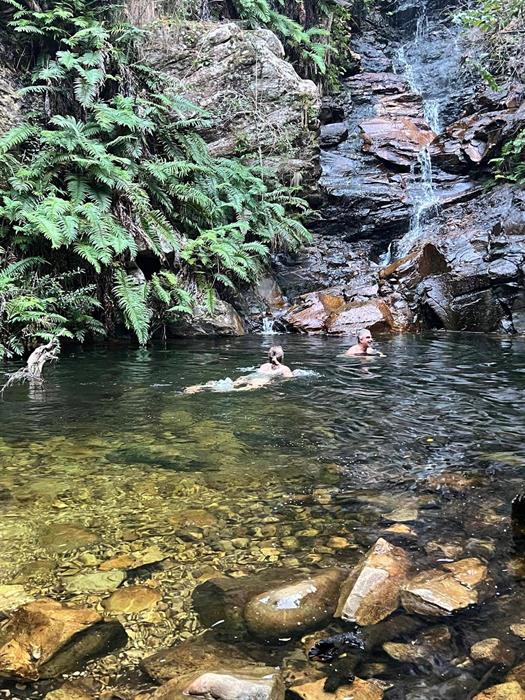 A swim spot in the valley at Wild Spirit Backpackers Lodge in Natures Valley. Photo: Marguerite van Ginkel
The Garden Route’s reputation as a leading self-drive destination supports this new era of flexible, tech-enabled travel. However, stakeholders are recognising that adapting to AI-driven planning and influencer-led discovery is essential.
As visitor behaviour continues to evolve, the region’s future growth will depend not only on its natural beauty and attractions, but also on how effectively it positions itself within the digital platforms now guiding travel decisions.
 Forest path on the Brownhooded Kingfisher Trail in Wilderness. Photo: Marguerite van Ginkel
‘We bring you the latest Garden Route, Hessequa, Karoo news’