

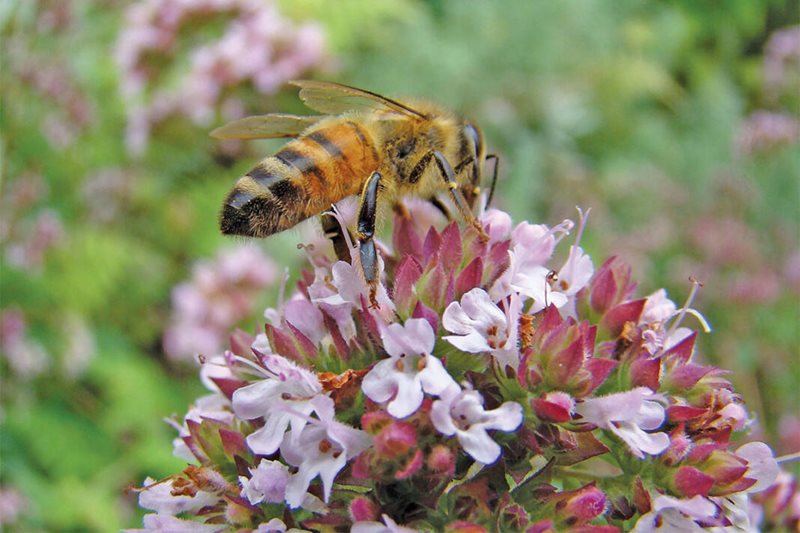
AGRICULTURE NEWS - Bee populations around the world are declining for various reasons, including habitat reduction, pesticide use, and diseases.
To maintain healthy bee populations, beekeepers need to carefully manage their hives to ensure that bees have enough food, are not exposed to diseases, and can flourish in their environments.
Blooming orchards might be mistaken as having ample food for bees. But Inge Austin, beekeeper and owner of The Beeger Picture in Nelspruit, Mpumalanga, says that looks can be deceiving.
“Different crops have different levels of nutrition. Some flowers have sufficient pollen and nectar, others will have only one or the other, and many plants have virtually no food value for bees. Bees not only require sufficient pollen and nectar to thrive but also a diverse source of these foods,” she says.
Dawn Noemdoe, beekeeper and founder of HoneyatDawn in Wellington, Western Cape, says the often-repeated phrase ‘save the bees’ should instead be ‘feed the bees’: “We don’t have a shortage of bees but a shortage of forage.”
She says that ensuring her bees have enough food is one of her biggest concerns.
“Because bees need both nectar and pollen from flowering plants, I need to be able to tell if their diet is balanced enough. The first thing I learnt was to check inside the hive; if my bees are storing plenty of pollen in their frames and have good honey reserves, it is a good sign.”
Noemdoe pays attention to the brood pattern. “Healthy larvae and capped brood mean the queen is laying well and the colony has enough nutrition. Another important aspect is watching bee behaviour. If the bees are slow-moving, aggressive, or clustering outside of the hive instead of foraging, it could mean they’re struggling to find food.”
Bees need to get to work as soon as they arrive in an orchard. Upon arrival, they should therefore already be at their strongest.
“Some crops have a very small window in which pollination can take place. If weak bees are placed in the orchard and expected to build their strength after feeding on the blooms, it could take weeks before they are functioning optimally, and the pollination window can be completely missed,” says Austin.
A further challenge facing beekeepers and farmers requiring pollination services is that the timing of hive placement in an orchard and food availability don’t always coincide.
Austin notes that before orchards are in bloom, there often isn’t a lot of food for bees placed there too early. This means colonies aren’t at optimal strength when they need to start working. Therefore, bees might need to be fed to boost them if flowering is delayed.
“To increase a bee colony, you need sufficient numbers of field bees, house bees, and larvae. It takes 18 days for larvae to grow into house bees. House bees work indoors for 22 days before going outside to work. They then spend around 10 to 24 days foraging, pollinating, and bringing food back to the hive.
“This means that 40 days before the bees are needed in an orchard, they need to be fed to get the worker bees to sufficient numbers. If this process starts too late, the pollination process can be delayed,” explains Austin.
She adds that if there isn’t sufficient food where the hives have been placed, bees could abscond. Insufficient food also causes the queen to stop laying eggs.
“Larvae production requires pollen, while nectar provides the energy for the worker bees and the larvae. If the pollen and nectar are absent or of bad quality, larvae production will suffer and the hive will stagnate. And if the queen is no longer producing optimally, then the worker bees have no reason to go out into orchards looking for food, which means the blooms will not be pollinated,” explains Austin.
A minimum functioning pollination hive will have at least six to eight frames covered with bees, with two to three frames containing brood in different stages of development.
The chemical threat
The effect of pesticides on bees has been much publicised, yet Inge Austin, beekeeper and owner of The Beeger Picture in Nelspruit, Mpumalanga, emphasises that even products that don’t fall into an insecticide category can harm bees.
“There is no such thing as a bee-friendly chemical; some just affect bees more than others. Chemicals like fungicides, for example, don’t directly kill bees, but they reduce pollen fermentation, which is needed to feed the larvae. Eventually, the larvae die because they are not receiving optimal nutrition,” she explains.
The LD50 value is used to describe the toxicity of pesticides, which represents the dosage of a pesticide that kills 50% of a test population of bees. Chemicals with an LD50 value are considered ‘soft’.
“This is regarded as a ‘bee-friendly’ pesticide, but it can still kill half of your bees and can have long-term negative effects on your hives,” she adds. A further complication arising from pesticide contact is that bees end up transporting these chemicals into the hives, where the larvae and queen ingest it.
“Health will diminish and queens will lay fewer eggs. The workforce becomes lethargic and often disorientated when they are not healthy, which often also means they produce less royal jelly, which further reduces reproduction in the queen. The sperm viability of drones can also be reduced, which has a knock-on effect for several generations of bees.”
The bio-accumulation of the pesticides in the hives continue to affect bees for several seasons, resulting in bees that do not perform optimally. Austin notes, however, that while avoiding all chemicals isn’t always practical, their use can be minimised with careful application.
“If chemicals are to be applied, it should be done at night and completed by 2am. This provides sufficient time for the chemicals to dry before bees start foraging in the early morning. Communication between beekeepers, growers and neighbours about spray programmes and times is crucial to prevent chemicals from one farm affecting bee colonies of adjacent properties,” she says.
A royal diet
Providing an optimal diet for bees entails ensuring that sufficient wild forage is available. This means food is available year-round for bees, and provides the diversity needed for optimal health.
Austin refers to foundation plants that all farmers and beekeepers should plant. For frost-free areas, the best option is African blue basil, which flowers profusely and continuously. For areas that receive frost, Austin recommends Margaret Roberts lavender.
The latter is however only a good nectar source and does not provide pollen. Additional forage, or supplementary feeding, is therefore needed to ensure bees get sufficient pollen. Both African blue basil and Margaret Roberts lavender can be planted along fences and roads.
“Foundation plants provide a good baseline, but should not be the only food source. Herbs are generally a good food source, but they don’t flower continuously throughout the year. Plants must be mixed and matched to ensure that flowering is staggered throughout the year so that there is always food for the bees,” says Austin.
Article: Farmer's Weekly
‘We bring you the latest Garden Route, Hessequa, Karoo news’